Master contract manufacturing to scale production efficiency, manage expenses, and bring high-quality products to market fast. Learn workflows, pricing, and benefits with Precintl’s expert guide today!
Manufacturing a new product from scratch involves complex decisions. Building facilities, procuring heavy machinery, and training technical staff demand vast capital and years of preparation. Consequently, growing brands, startups, and established enterprises rely on a contract manufacturer to handle physical production.
Outsourced manufacturing transforms how hardware and hardware-enabled software products reach store shelves. Working with an experienced contract manufacturing company shifts financial risk away from capital expenditure toward manageable operating costs. This guide at Precintl covers how contract manufacturing works, total operational costs, key strategic benefits, and steps to select an effective production team.
What Is Contract Manufacturing?
Contract Manufacturing Definition
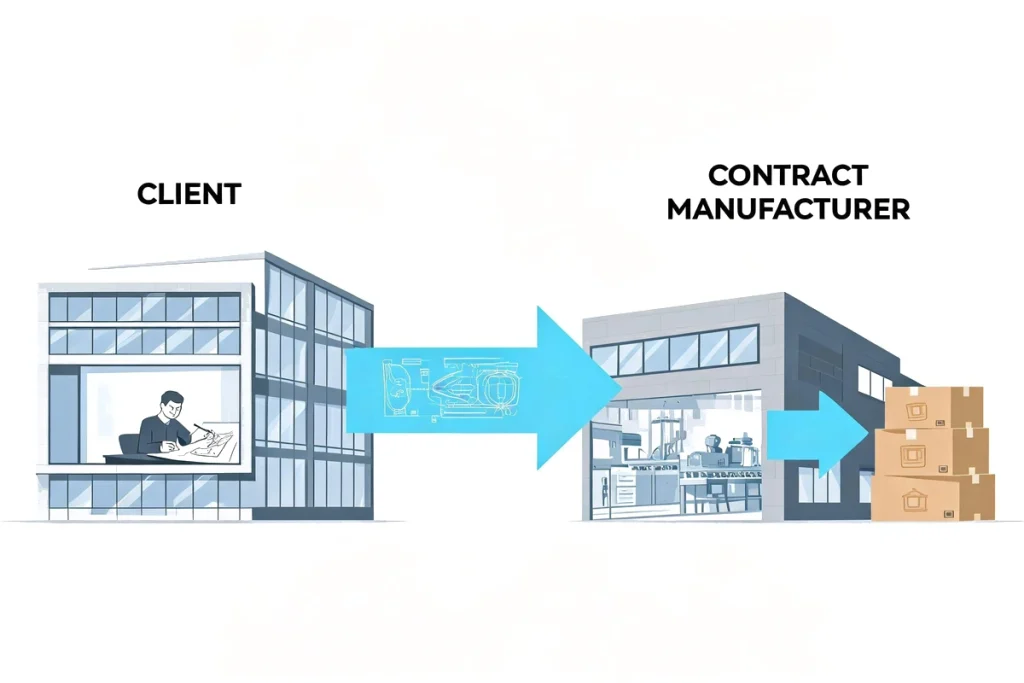
Contract manufacturing is a business arrangement where a firm hires a third-party factory to produce components, sub-assemblies, or complete physical goods. Under a clear manufacturing agreement, the hiring company provides product specifications, technical drawings, and quality standards, while the contract manufacturer handles physical execution, labor, and facilities management.
How Contract Manufacturing Works
| Party | Core Responsibilities |
| Hiring Brand | Owns IP and design, manages sales & marketing, defines quality and product specifications |
| Contract Manufacturer | Provides production facilities and labor, handles component sourcing & assembly, executes shop-floor quality inspection |
What Does a Contract Manufacturer Do?
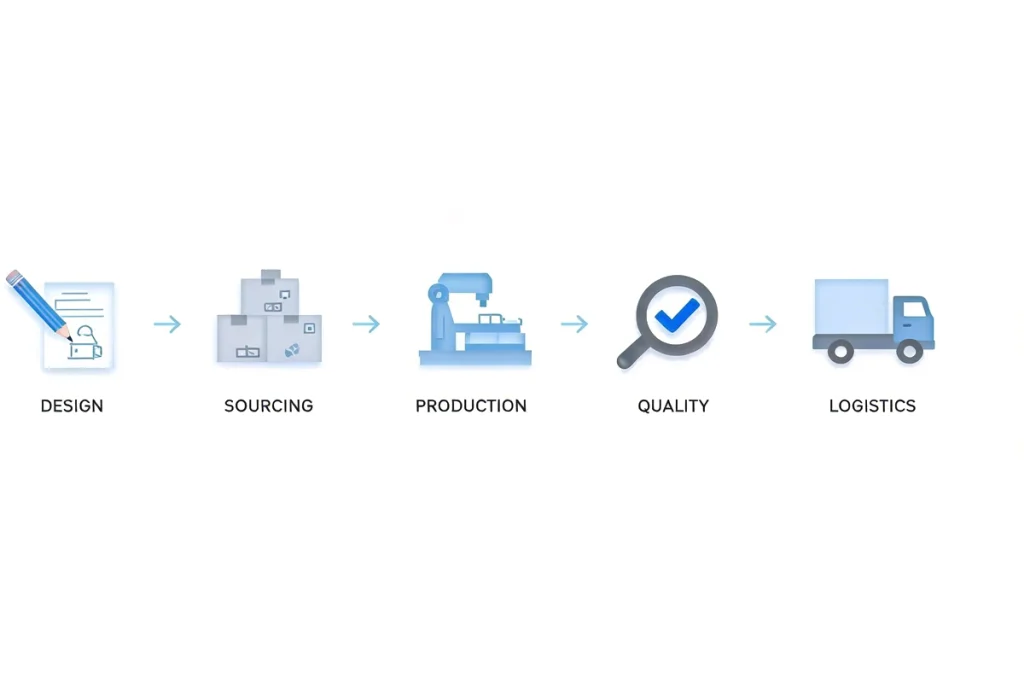
Modern contract manufacturing companies offer broad capabilities well beyond simple assembly. Their service spectrum includes:
- Sourcing raw materials and managing global supply chain sourcing.
- Building complex custom tooling and molds.
- Running surface-mount technology (SMT) lines for PCB assembly.
- Implementing detailed quality control procedures across every shift.
- Finalizing custom product packaging and orchestrating outbound logistics.
Who Uses Contract Manufacturing?
Businesses of all sizes use contract manufacturing services. Hardware startups rely on contract production to avoid building multi-million-dollar factories. Mid-market companies use outsourced production to expand regional distribution without heavy capital investment. Large global brands frequently leverage full service contract manufacturing to preserve liquidity, manage seasonal volume surges, and focus core teams on marketing and research.
How Does the Contract Manufacturing Process Work?
Contract Manufacturing Workflow Overview
| Step | Phase | Key Action Items |
| 1 | Product Requirements & Specifications | Finalize engineering BOM, CAD models, and tolerance parameters. |
| 2 | Product Design & Engineering | Conduct DFM reviews, optimize thermal performance and panelization. |
| 3 | Prototyping & Product Validation | Perform EVT, test signal integrity, and resolve design flaws. |
| 4 | Tooling & Manufacturing Preparation | Fabricate injection molds, custom SMT stencils, and test fixtures. |
| 5 | Pilot Production | Run trial builds to isolate line bottlenecks and validate cycle times. |
| 6 | Mass Production & Quality Control | Execute high-volume assembly, in-line checks, and functional testing. |
| 7 | Packaging & Delivery | Apply custom branding, set up retail packaging, and stage global logistics. |
Product Requirements and Specifications
Every successful contract manufacturing process starts with structured technical documentation. A complete engineering bill of materials (BOM), detailed 3D CAD files, component sourcing parameters, and clear tolerance expectations prevent downstream misunderstandings. Missing or vague product specifications inevitably cause budget overruns and field failures.
Product Design and Engineering
Before launching factory equipment, mechanical and electrical engineers review drawings using DFM (Design for Manufacturability) guidelines. Engineers evaluate layout efficiency, panelization, thermal performance, and tolerance stack-ups. Adapting designs early eliminates complex manual operations during assembly and testing.
Prototyping and Product Validation
Physical engineering models validate form, fit, and electronic functionality. Iterative functional models evaluate thermal dissipation, mechanical stress, and electronic signal integrity. Engineers perform rigorous engineering validation tests to catch design flaws long before cutting steel molds or ordering volume components.
Tooling and Manufacturing Preparation
High-volume production relies on custom tooling, jigs, and fixtures. For custom plastic parts, steel injection molding dies require precise machining and polishing. Electronics assembly requires custom SMT stencils, test fixtures, and functional firmware programming stations to support quick line changes and consistent output.
Pilot Production
A pre-production run tests factory workflows, operator work instructions, and quality inspection checkpoints under real working conditions. Also referred to as a trial run, pilot production isolates line bottlenecks, verifies true cycle times, and validates custom test equipment prior to full factory sign-off.
Mass Production and Quality Control
When the pilot run clears engineering checks, full mass production begins. Automated assembly lines build goods according to established work instructions. Quality assurance engineers inspect incoming raw materials, conduct in-line checks, and run 100% functional testing on finished goods before release.
Packaging and Delivery
Finished products undergo final visual screening, custom branding application, and product packaging setup. Assemblies are boxed with manuals, accessories, and protective inserts. Factory logistics teams stage shipment pallets, generate customs paperwork, and hand off goods to logistics carriers.
Related: What Is MOQ in Manufacturing? Complete Guide for Businesses
What Services Does a Contract Manufacturer Provide?
Product Design and Development
Leading partners provide initial product design support alongside engineering refinements. Mechanical, electrical, and firmware engineers collaborate to transform initial concepts into practical, reliable hardware suitable for volume production.
Prototype Manufacturing
Fast-turn prototype manufacturing confirms physical ergonomics and circuit layout. Utilizing rapid SLA/SLS 3D printing, short-run CNC machining, and prototype PCBA manufacturing, production teams deliver functional evaluation units in days rather than months.
Component Sourcing and Supply Chain Management
Contract manufacturers leverage global purchasing volume to secure favorable component pricing. Robust supply chain management prevents production downtime by evaluating vendor lead times, tracking market availability, and sourcing alternative certified components when shortages strike.
Electronics Manufacturing and PCB Assembly
Modern electronics contract manufacturing hinges on precise SMT line configuration. High-speed pick-and-place equipment mounts micro-scale passives and dense IC packages onto raw circuit boards. Optical and X-ray inspection verify joint integrity across complex surface-mount and through-hole designs.
| Production Stage | Primary Inspection Method | Purpose |
| Surface Mount Technology (SMT) | Automated Optical Inspection (AOI) | Verifies component placement, orientation, and solder joint geometry |
| Ball Grid Array (BGA) Assembly | 3D X-Ray Inspection (AXI) | Detects hidden solder bridges and voids beneath IC chips |
| Functional Testing (FCT) | Custom Test Fixture / Firmware | Confirms circuit voltage, signal integrity, and operational features |
Mechanical Manufacturing and Product Assembly
Enclosure production utilizes diverse mechanical manufacturing processes:
- Custom injection molding for high-volume plastic enclosures.
- High-precision CNC machining for metal chassis, structural mounts, and custom heat sinks.
- Sheet metal fabrication for rugged industrial housings.
- Final mechanical assembly joining internal circuit boards, wire harnesses, displays, and outer shells.
Product Testing and Quality Inspection
Robust quality assurance combines automated checking with structured manual verification. Factories execute environmental testing, drop testing, vibration checks, and prolonged burn-in testing to guarantee field reliability and compliance with industry safety standards.
Packaging and Production Support
End-to-end manufacturing services manage retail-ready retail packaging, custom inserts, serialization, barcode tracking, and direct bulk fulfillment to international distribution hubs.
What Types of Products Can Be Contract Manufactured?
Product Categories Overview
| Industry Segment | Representative Products | Key Manufacturing Requirements |
| Consumer Electronics | Audio gear, handheld devices, gaming systems | Tight mechanical tolerances, premium surface finishes, automation |
| IoT & Connected Devices | Gateway routers, asset trackers, smart sensors | RF antenna tuning, low-power optimization, firmware programming |
| Wearable Technology | Fitness bands, health monitors, smart rings | Micro-scale PCBA, flexible circuits, overmolding, waterproof sealing |
| Smart Home Products | Smart locks, connected lighting, climate hubs | Balance of consumer aesthetic design and industrial-grade reliability |
| Industrial Electronics | Automation controllers, rugged edge nodes | Conformal coating, potting, high thermal/vibration resistance |
| Custom Products (NPI) | Proprietary commercial hardware, medical gear | Specialized tooling, low-to-high volume scaling, strict compliance |
Consumer Electronics
From wireless audio devices to handheld gaming systems, high-volume consumer hardware requires tight mechanical tolerances, advanced surface finishes, and automated assembly workflows in Consumer Electronics.
IoT and Connected Devices
Internet of Things hardware demands complex electronic contract manufacturing services. Integration requires expert antenna tuning, RF shielding validation, micro-controller programming, and low-power circuit optimization.
Wearable Technology
Wearables combine miniature PCB layout, flexible circuits, overmolded silicone, and water-resistant sealing. Precise micro-assembly is essential for long-term reliability under daily wear.
Smart Home Products
Smart lighting, automated security devices, and connected home appliances balance consumer-grade aesthetic design with industrial-grade electronic reliability.
Industrial Electronics and Hardware
Heavy industrial controllers, power conversion modules, and rugged sensor nodes require specialized potting, conformal coating, and strict component selection to endure harsh operational environments.
Custom Products and New Product Development
Custom product manufacturing structures scalable assembly paths for specialized devices, niche commercial hardware, and entirely novel hardware innovations.
What Are the Benefits of Contract Manufacturing?
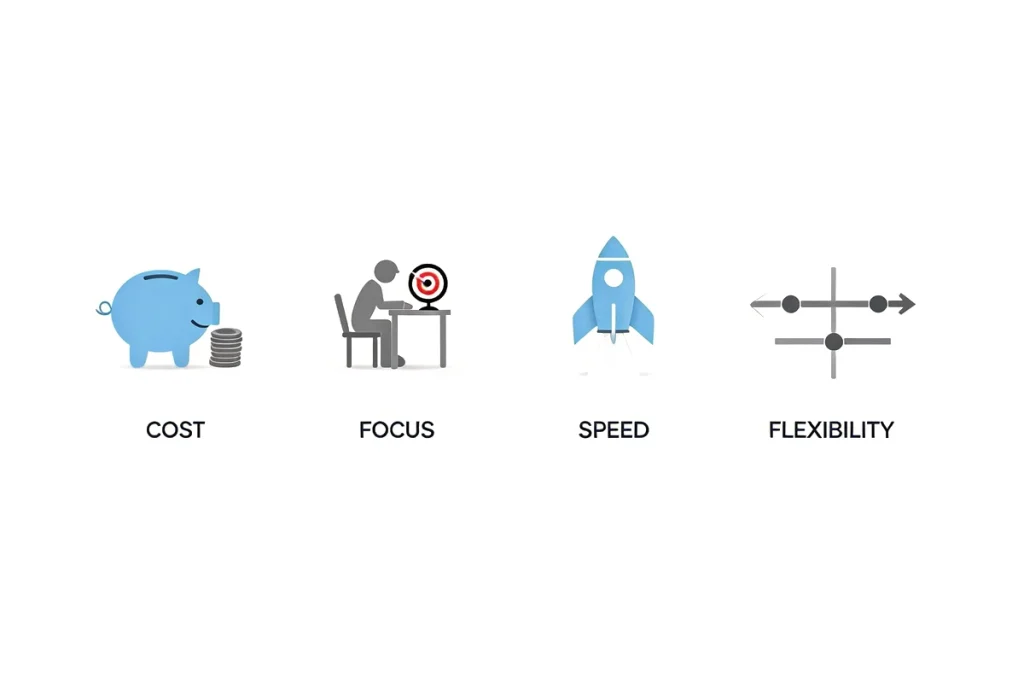
| Strategic Benefit | Operational Impact |
| Lower Manufacturing Investment | Converts heavy fixed capital expenditure (CapEx) into flexible operating costs (OpEx). |
| Expertise Access | Taps into established teams of veteran DFM, mechanical, and electrical engineers. |
| Faster Time to Market | Leverages pre-built production lines and existing supplier networks to cut setup time. |
| Flexible Production Scaling | Adjusts output seamlessly up or down based on real-time market demand. |
| Established Supply Chains | Benefits from the partner’s bulk purchasing power to secure lower component costs. |
| Focus on Core Growth | Frees internal resources to concentrate on product design, software, marketing, and sales. |
Lower Manufacturing Investment
Building a dedicated factory demands capital for real estate, industrial machinery, environmental controls, and specialized labor. Outsourcing eliminates these capital expenditures, allowing brands to convert fixed operational costs into variable per-unit costs.
Access to Engineering and Manufacturing Expertise
Partnering with an established manufacturer gives brands access to veteran mechanical engineers, quality managers, and line technicians. Experienced production teams spot design oversights early, reducing expensive design revisions.
Faster Time to Market
Building and certifying an internal factory line often takes 12 to 18 months. An established manufacturing partner offers ready-to-use production lines, certified quality frameworks, and trained operators, dramatically reducing time to market.
Flexible Production Scaling
Market demand shifts quickly. Contract manufacturing allows companies to scale up volume seamlessly during peak sales cycles or throttle back production without keeping idle factory workers on staff.
Access to Established Supply Chains
Established factories leverage long-standing supplier relationships to negotiate volume pricing on components and raw materials. Their buying power reduces unit costs and grants priority allocation during global material shortages.
Focus on Product Development and Business Growth
Offloading factory floor operations frees internal teams to focus on core competencies: product design, software development, marketing, brand strategy, and sales channel expansion.
What Are the Challenges of Contract Manufacturing?
| Risk / Challenge | Practical Mitigation Strategy |
| Quality Control Consistency | Define explicit Work Instructions, Acceptance Quality Limits (AQL), and conduct third-party audits. |
| Minimum Order Quantities (MOQ) | Negotiate phased delivery schedules or tiered pricing aligned with growth projections. |
| Supply Chain Disruptions | Mandate dual-sourcing for critical components and maintain an Approved Vendor List (AVL). |
| Communication & Specs | Deploy dedicated bilingual project managers and enforce standardized CAD/BOM documentation. |
| IP Protection Risks | Enforce non-disclosure agreements (NDAs) and compartmentalize sub-assembly workflows. |
Quality Control and Production Consistency
Inconsistent quality control can damage brand reputation. Offsite factory teams require detailed Work Instructions, explicit Acceptance Quality Limits (AQL), and continuous oversight to prevent product defects.
Minimum Order Quantities and Production Costs
Factories set Minimum Order Quantities (MOQs) to cover line setup and material purchasing costs. Small batches often face higher unit costs, making careful cash flow management critical for startups.
Supply Chain and Component Availability
Global supply chain disruptions can delay production lines. Long-lead components, single-source silicon chips, and freight delays require continuous component monitoring and proactive dual-sourcing strategies.
Communication and Technical Requirements
Time zone differences, language barriers, and incomplete engineering drawings can cause production missteps. Successful manufacturing partnerships rely on detailed documentation and clear communication protocols.
Intellectual Property Protection
Sharing proprietary CAD models, schematics, and code with third parties carries risk. Protecting corporate IP requires strict confidentiality agreements, compartmentalized sub-assembly workflows, and carefully structured factory contracts.
Related: EMS Electronic Manufacturing Explained: From Design to Mass Production (2026)
How Much Does Contract Manufacturing Cost?
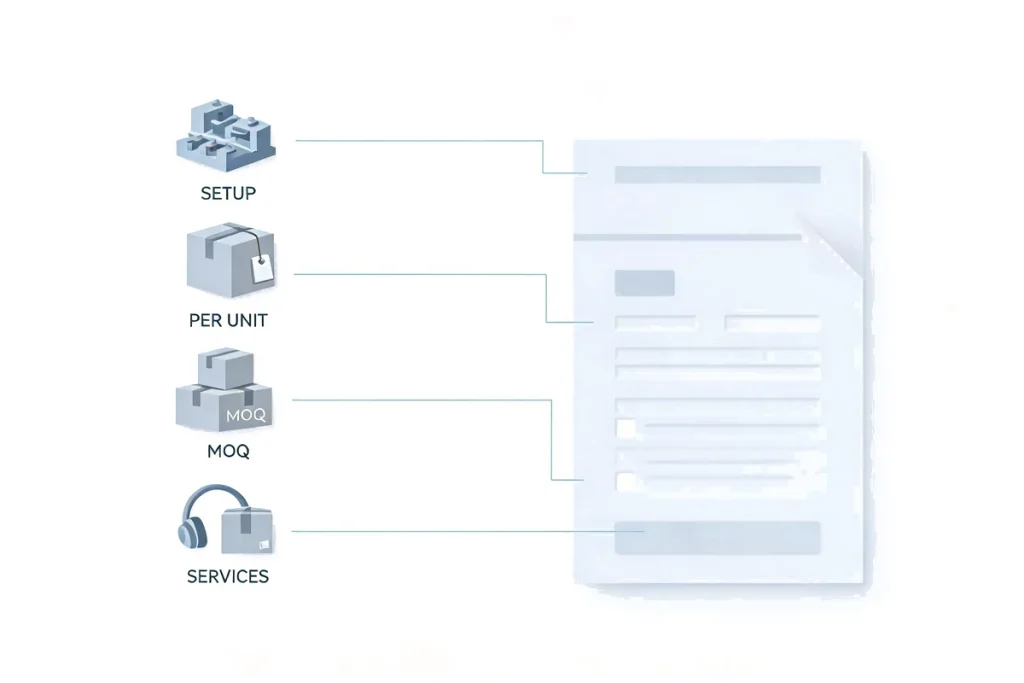
Cost Structure Breakdown
| Cost Category | Direct Elements | Impact on Budget |
| NPI & Engineering | DFM analysis, line layout, test development | Upfront fixed fee |
| Tooling & Molds | Steel injection dies, SMT stencils, CNC jigs | Upfront capital investment |
| BOM & Materials | Active ICs, passives, PCB substrates, enclosures | Variable unit cost (COGS) |
| Assembly & Testing | SMT line time, manual assembly labor, FCT testing | Variable unit cost |
| Logistics & Duties | Master cartons, ocean/air freight, customs tariffs | Variable landed cost |
Product Design and Engineering Costs
Initial expenditures cover design review, DFM optimization, PCB layout refinement, and custom test development. Spending on front-end engineering prevents expensive line revisions during volume production.
Prototype and Tooling Costs
Tooling and mold development is a key upfront cost. High-grade hardened steel injection molds can range from $5,000 to over $50,000 based on part geometry, steel selection, and cavity count. High-density SMT stencils and specialized test fixtures add incremental setup fees.
Materials and Component Costs
The Bill of Materials (BOM) accounts for the largest portion of overall unit costs. PCB substrates, active ICs, passive components, custom connectors, and structural enclosures directly establish the baseline cost of goods sold (COGS).
Assembly, Testing, and Quality Costs
Operational assembly costs depend on cycle times, line automation, manual insertion needs, and testing length. Running full functional testing and extended burn-in cycles increases unit costs, but prevents expensive field returns.
Shipping and Logistics Costs
Total landed cost includes master carton packaging, freight delivery, export clearance fees, customs duties, and warehouse staging.
Factors That Affect Contract Manufacturing Costs
| Cost Factor | High-Cost Scenario | Cost-Optimization Strategy |
| Enclosure Material | Multi-axis CNC Machined Aluminum | High-cavity Plastic Injection Molding |
| Component Selection | Rare, single-source ICs with long lead times | High-volume pin-compatible alternatives |
| Circuit Board Layout | 10-layer dense PCB with micro-vias | Standard 4-layer or 6-layer panelization |
| Quality Testing | 100% prolonged environmental burn-in | Automated inline test fixtures with statistical sampling |
Contract Manufacturing vs OEM vs ODM
| Comparison Feature | Contract Manufacturing | OEM Manufacturing | ODM Manufacturing |
| IP Ownership | Hiring Brand (100% Custom) | Hiring Brand (Custom Specs) | Factory / Manufacturer |
| Product Customization | Completely Custom | Subsystem / Module Level | Standard White-Label |
| Design Effort Required | High (Client provides specs) | Medium (Client integrates modules) | Low (Client picks catalog item) |
| Time to Market | Medium to Long | Medium | Fastest |
| Best Used For | Proprietary custom hardware | Standard modular subsystems | Rapid branding of standard items |
Contract Manufacturing vs OEM
While contract production and OEM manufacturing are often used interchangeably, key operational differences exist:
- Contract Manufacturing: The hiring brand provides all product specifications and technical IP. The factory serves purely as a custom contract manufacturing execution team.
- OEM Manufacturing: An OEM produces standardized components or subsystems (such as displays or power supplies) that another company integrates into its final branded assembly.
Contract Manufacturing vs ODM
ODM manufacturing (Original Design Manufacturing) uses a different model:
- ODM Model: The factory owns the underlying product design and IP. Clients select pre-engineered “white-label” models, apply custom logos, and sell them directly.
- Contract Manufacturing Model: The brand owns all proprietary IP, mechanical tooling, schematics, and firmware, retaining total control over technical features and design updates.
How to Choose the Right Manufacturing Model
- Choose ODM if speed-to-market is the primary goal and unique IP is not required.
- Choose OEM when buying off-the-shelf modules to integrate into a larger proprietary system.
- Choose Contract Manufacturing when launching an entirely custom product with valuable proprietary IP, unique aesthetic design, and strict quality requirements.
Related: OEM vs ODM Manufacturing: Which Is Right for Your Product?
How to Choose a Contract Manufacturer
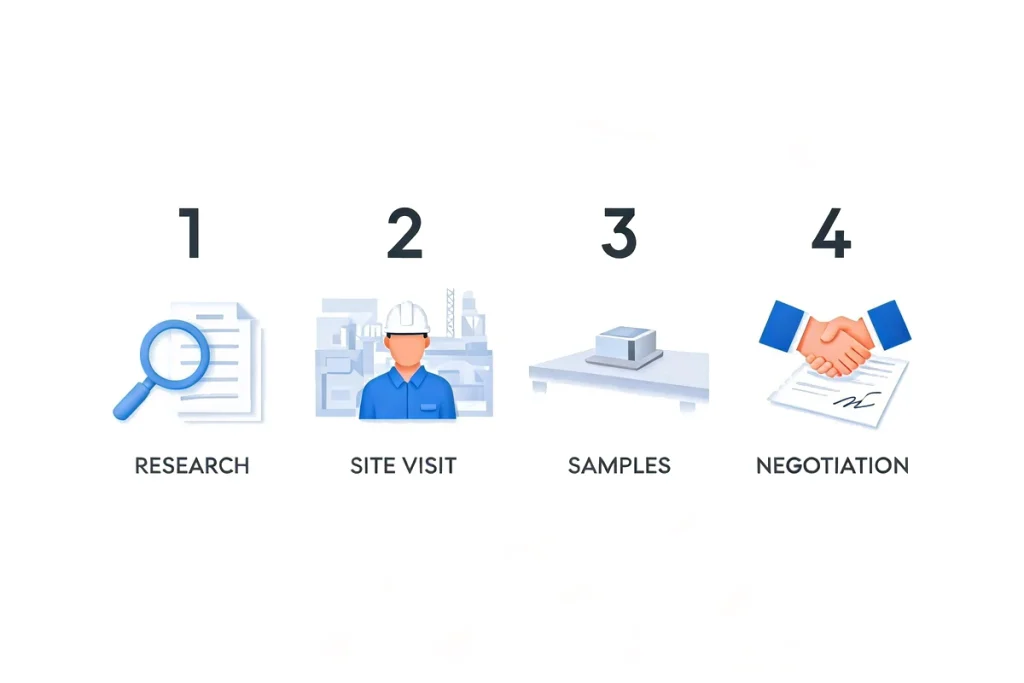
Partner Evaluation & Audit Matrix
| Evaluation Criteria | Key Verification Steps |
| Technical Capabilities | Audit SMT placement accuracy, CNC machinery precision, and DFM expertise. |
| Quality Management | Verify active ISO certifications (ISO 9001, ISO 13485, IATF 16949). |
| Scalability & Capacity | Evaluate total floor space, shift flexibility, and peak-season expansion plan. |
| Prototyping & NPI | Assess dedicated NPI labs, rapid turnaround times, and sample validation teams. |
| Commercial Terms | Review MOQs, lead times, payment milestone flexibility, and setup fees. |
| IP Security Practices | Inspect physical line security, restricted server access, and NDA enforcement. |
Evaluate Engineering and Manufacturing Capabilities
Audit the vendor’s actual hardware capabilities. Confirm that their team has hands-on experience with your product type—whether that requires fine-pitch SMT placement, high-density interconnections, multi-shot injection molding, or precision CNC machining.
Check Quality Control and Certifications
Inspect physical quality documentation on the factory floor. Ensure the manufacturer maintains ISO certifications tailored to your industry:
- ISO 9001: Standard quality management.
- ISO 13485: Medical device manufacturing standards.
- IATF 16949: Automotive production standards.
Review Production Capacity and Scalability
Ensure the factory can handle both initial low-volume pilot runs and rapid volume expansion without sacrificing quality or lead times.
Evaluate Prototyping and NPI Capabilities
Verify that the manufacturer maintains a dedicated New Product Introduction (NPI) team. Isolated NPI workflows ensure prototype runs get immediate engineering focus without getting delayed by high-volume factory orders.
Review MOQ, Lead Times, and Costs
Look beyond unit pricing. Compare minimum order requirements, tool development lead times, component lead times, and payment terms to get a clear picture of total cost and operational risk.
Verify Intellectual Property and Confidentiality Practices
Ensure the partner enforces strict IP safeguards. Review non-disclosure agreements (NDAs), check internal server access controls, and confirm physical factory security to keep your product designs safe.
Why Choose Precintl for Contract Manufacturing?
| Phase | Core Focus | Primary Goal |
| EVT (Engineering Validation Test) | PCB functional performance, circuit bugs, basic firmware | Verify schematics and operational logic |
| DVT (Design Validation Test) | Mechanical enclosures, drop tests, environmental stress | Pass compliance certs and physical specs |
| PVT (Production Validation Test) | Factory line speed, operator instructions, assembly jigs | Finalize high-yield mass production lines |
From Product Concept to Manufacturing
Precintl bridges the gap between early design concepts and high-volume production. We manage the entire product lifecycle under one roof, eliminating the friction of balancing separate design agencies and factories.
Product Design, Prototyping, and Engineering
Our engineering team turns rough ideas into production-ready designs. We provide comprehensive turn-key services including:
- Custom mechanical enclosure design and industrial design refinement.
- Schematic capture, multi-layer PCB layout, and thermal analysis.
- High-speed prototype manufacturing for rapid functional validation.
EVT, DVT, and PVT Validation
We guide hardware projects through every phase of new product development:
- Engineering Validation Test (EVT): Verifies that core electronic circuits and functional code work to specification.
- Design Validation Test (DVT): Confirms that mechanical enclosures, environmental sealing, and cosmetic finishes meet performance standards.
- Production Validation Test (PVT): Tests production tooling, assembly jigs, and line speeds at scale.
Pilot Production to Mass Production
Precintl manages the transition from low-volume pilot builds to high-volume mass production. By optimizing assembly line layouts and refining automated test fixtures, we maintain consistent yield rates as production scales.
Global Supply Chain and Manufacturing Support
Our component sourcing teams manage material procurement, track component lead times, and secure priority allocations through an established network of qualified vendors. We handle incoming component inspection, customs clearances, and international logistics.
Custom Product Development for Businesses
Whether you are developing smart IoT nodes, wearable medical electronics, or commercial industrial hardware, Precintl provides end-to-end manufacturing solutions built around your business goals.
Frequently Asked Questions About Contract Manufacturing
What is contract manufacturing?
Contract manufacturing is a business partnership where a hiring company outsources physical product assembly, component sourcing, and quality control to a specialized third-party factory while retaining full ownership of the product’s intellectual property.
What does a contract manufacturer do?
A contract manufacturer provides equipment, production facilities, skilled labor, and operational management to build physical goods according to client specifications. Their services cover component sourcing, PCB assembly, custom injection molding, product testing, and final retail packaging.
What is the difference between OEM and contract manufacturing?
In contract manufacturing, the factory builds a fully custom product based entirely on technical designs supplied by the client. In an OEM model, the factory produces standard sub-assemblies or modules that companies buy to integrate into their own finished products.
What is the difference between ODM and contract manufacturing?
An ODM (Original Design Manufacturer) designs and builds white-label products that clients rebrand with minimal design changes. Contract manufacturing involves building a 100% custom product where the hiring brand owns all engineering designs, schematics, and mechanical tooling.
How much does contract manufacturing cost?
Costs depend on part complexity, tooling investments, component prices, assembly labor, and volume scale. High-volume runs lower per-unit assembly costs, while specialized custom tooling requires upfront capital investment.
What is the typical MOQ for contract manufacturing?
Minimum Order Quantities vary based on the production process. High-volume automated SMT lines or large injection molding runs may require MOQs of 1,000 to 5,000 units. Specialized custom hardware lines often offer lower initial batch sizes during pilot development.
How long does contract manufacturing take?
Overall lead times depend on product complexity. Prototype manufacturing and DFM reviews take 2 to 4 weeks. Custom injection mold tooling requires 4 to 8 weeks. Once tooling and supply chains are established, mass production runs typically take 4 to 6 weeks.
Can a contract manufacturer design a product from scratch?
Yes. Full-service partners like Precintl offer comprehensive product design and engineering capabilities. We turn initial ideas into production-ready CAD files, electrical schematics, and validated prototypes before launching mass production.
How do I choose a reliable contract manufacturer?
Evaluate partners based on relevant industry experience, certified quality management systems (such as ISO 9001), clear IP protection policies, dedicated NPI capabilities, transparent pricing structures, and clear communication channels.