Master the complete electronics manufacturing process from hardware design to high-volume production. Learn how electronic manufacturing services (EMS), OEM, and ODM partners build smart devices. Contact Precintl today to start your product development project!
Building hardware requires bridging the gap between an early engineering prototype and a scalable, market-ready device. Companies developing new hardware encounter mechanical, electrical, and logistics obstacles long before the first production run starts. Partnering with a skilled contract manufacturing provider transforms early concepts into reliable hardware that scales efficiently across global supply chains.
Why Electronic Manufacturing Services Are Critical for Modern Product Companies
Hardware brands face mounting pressure to compress development timelines while keeping unit costs low and quality high. Modern electronic manufacturing services handle complex technical tasks, including precision component sourcing, printed circuit board assembly, enclosure fabrication, and regulatory certification testing. Outsourcing these tasks allows product brands to direct internal resources toward software, user acquisition, and market positioning while relying on specialized factory infrastructure for production.
Who This Guide Is For
This guide at Precintl serves hardware founders, chief technology officers, lead design engineers, and supply chain managers evaluating production strategies. Whether bringing an IoT sensor from prototype to production manufacturing or scaling a mature commercial product line, this document outlines how electronic manufacturing services operate from initial schematics to global delivery.
What Is EMS (Electronic Manufacturing Services)?
Understanding how contract assembly and turnkey production function helps brands choose the right strategy for their hardware roadmap.
EMS Definition in Simple Terms
Electronic manufacturing services (EMS) refers to companies that design, test, manufacture, distribute, and provide return/repair services for electronic components and assemblies for original equipment manufacturers. An EMS provider operates specialized facility lines, buying raw components, populating circuit boards, and constructing finished physical goods on behalf of client brands.
What an EMS Provider Is Responsible For
A full-service electronic manufacturing company assumes responsibility for raw materials procurement, surface mount assembly, mechanical enclosure integration, and quality testing. They execute factory audits across their vendor network, manage bill of materials (BOM) changes, and enforce structural compliance to ensure every unit shipped matches engineering schematics.
Where EMS Fits in the Product Development Lifecycle
EMS integration begins during early hardware development or PCB layout reviews. Involving a production team before locking down schematics allows engineers to identify long-lead components, fix physical layout bottlenecks, and run design for manufacturability analysis prior to mass production services.
How the EMS Process Works: From Concept to Mass Production
Transforming an initial schematic into thousands of boxed products follows a structured hardware execution cycle.
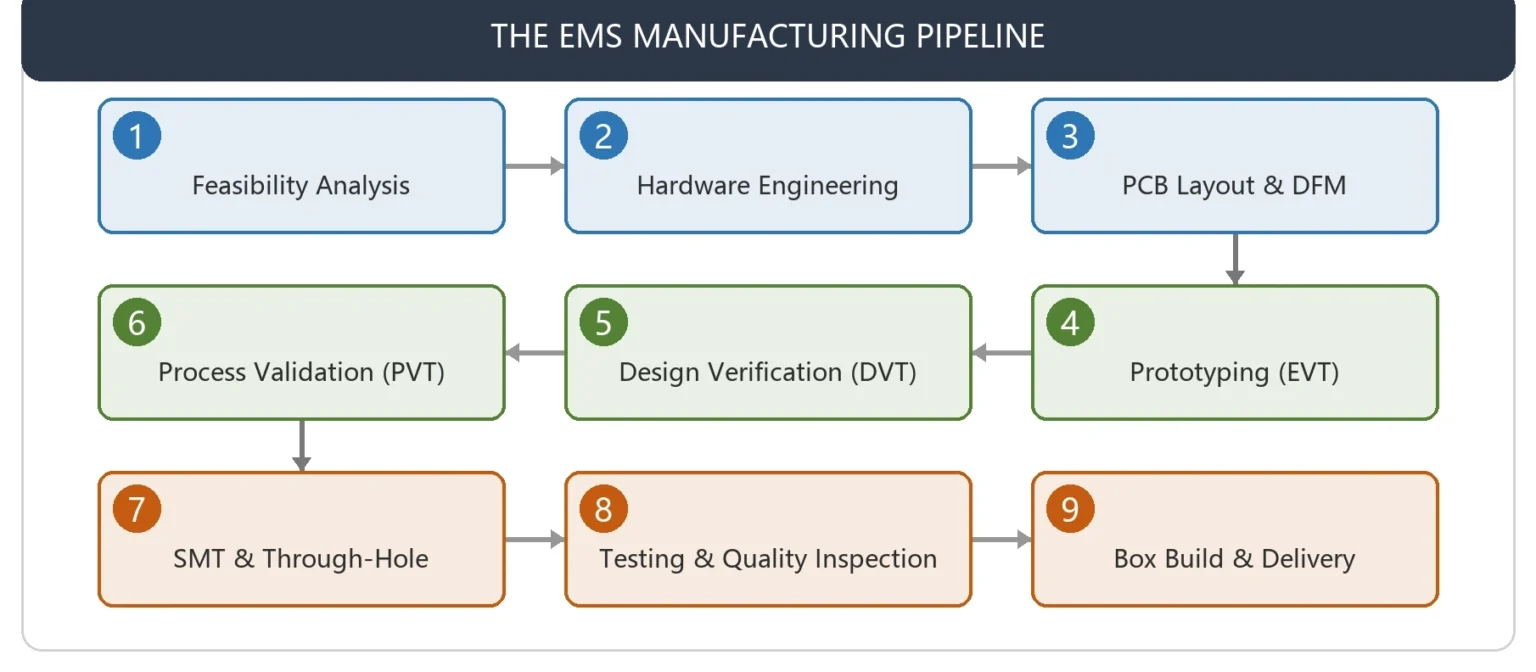
Product Requirements & Feasibility Analysis
Every project begins by establishing clear engineering requirements. The engineering team evaluates product specifications, target bill-of-materials cost, operational environments, and power demands to confirm feasibility before ordering physical parts.
Electronic Hardware Design Support
During initial hardware development, engineers refine the schematic architecture. They select microcontrollers, passive components, and power management ICs while ensuring parts remain available throughout the expected lifecycle of the product.
PCB Design & Engineering
Transitioning from a schematic to a physical layout requires careful PCB design. Engineers lay out high-speed trace routing, layer stackups, ground planes, and thermal dissipation paths to prevent signal noise and electromagnetic interference.
Prototype Development
Initial electronic prototyping produces small runs (typically 5 to 20 units) to confirm functional performance. This stage tests core circuits, power rails, and wireless connectivity before investing in production tooling.
Design Verification & Product Refinement
Engineers stress-test early samples through environmental chambers and vibration tables. Refinements made during this phase correct circuit anomalies and thermal bottlenecks before launching pilot production lines.
Component Sourcing & Supply Chain Planning
Strategic component sourcing prevents factory downtime. Procurement teams establish relationships with authorized distributors, secure long-lead semiconductors early, and identify cross-referenced alternative components to defend against unexpected material shortages.
PCB Assembly (SMT & Through-Hole)
PCB assembly services bring circuit boards to life using Surface Mount Technology (SMT) for tiny, high-density micro-components, alongside Through-Hole Assembly for durable connectors, heavy transformers, and mechanical switches. Automated pick-and-place machinery places thousands of surface-mount devices per hour, followed by reflow soldering ovens that set permanent electrical connections.
Functional Testing & Quality Inspection
Assembled boards undergo rigorous quality checks, including automated optical inspection (AOI), in-circuit testing (ICT), and functional testing. Technicians program firmware and measure voltage outputs under simulated operational loads to ensure zero defect rates.
Box Build & Final Product Assembly
Once circuit boards pass testing, workers execute box build assembly. Technicians install boards into injection-molded plastic or CNC-machined metal enclosures, route internal cable assembly runs, insert lithium batteries, and apply final seals or gaskets.
Packaging, Logistics & Global Delivery
Final units undergo cosmetic inspections before getting packaged with user manuals, regulatory labels, and accessories. Production facilities then coordinate customs clearance, freight forwarding, and direct-to-warehouse logistics worldwide.
Related: Product Design Explained: How to Turn Your Idea into a Manufacturable Product (2026)
Core Services Offered by EMS Companies
A contract electronics manufacturer provides specialized solutions tailored to different stages of product maturity.
| Service Category | Primary Deliverables & Focus | Target Outcome |
|---|---|---|
| Service Category Product Engineering | Primary Deliverables & Focus Circuit schematic design, PCB layout, thermal management | Target Outcome Validated, manufacturable architecture |
| Service Category PCB Assembly Services | Primary Deliverables & Focus High-speed SMT, manual through-hole soldering, conformal coating | Target Outcome Functional populated circuit boards |
| Service Category Mechanical & Industrial Design | Primary Deliverables & Focus Enclosure styling, 3D modeling, injection mold tooling | Target Outcome Ergonomic, protective hardware housing |
| Service Category Firmware Integration | Primary Deliverables & Focus Bootloader installation, wireless stack programming, self-diagnostics | Target Outcome Cohesive hardware-software operation |
| Service Category Box Build Assembly | Primary Deliverables & Focus System integration, internal wiring, custom retail packaging | Target Outcome Ready-to-ship finished products |
Electronic Product Engineering
In-house product engineering teams optimize circuits for power efficiency and signal stability. They help clients transition rough breadboard concepts into dense, multi-layer printed circuit boards built for high-yield manufacturing.
PCB Assembly Services
Modern pcb manufacturing services utilize automated SMT lines capable of placing 0201 passive components and fine-pitch Ball Grid Arrays (BGAs). Facilities combine automated paste printing, 3D solder paste inspection (SPI), and multi-zone reflow ovens to guarantee joint integrity.
Mechanical & Industrial Design Support
Hardware requires protective, appealing physical enclosures. Industrial design teams balance aesthetics and ergonomics, while mechanical engineering specialists design internal ribs, snap-fits, screw bosses, and water-ingress seals ready for mass production services.
Firmware & Embedded System Integration
Hardware requires integrated software to function. EMS technicians flash custom firmware onto microcontrollers during board testing, setting secure boot keys, Bluetooth/Wi-Fi MAC addresses, and device calibration profiles.
Prototype Manufacturing
Fast-turn prototype manufacturing allows hardware engineering teams to validate physical hardware within days. Rapid iterations help teams confirm mechanical fit, antenna performance, and power draw prior to funding expensive mass-production molds.
Low-Volume Manufacturing
Emerging startups and niche commercial projects rely on low volume electronics manufacturing (500 to 5,000 units). This approach limits upfront capital risk while providing pilot units for early customers, clinical trials, or field deployments.
High-Volume Manufacturing
When demand scales, high volume electronics manufacturing shifts production to fully automated lines. Factory management focuses on minimizing cycle times, maximizing first-pass yields, and securing direct factory tier-1 pricing on raw components.
After-Sales Manufacturing Support
Reliable partners support products beyond the factory floor. Services include warranty repairs, board-level troubleshooting, engineering change order (ECO) retrofits, and end-of-life component replacement management.
Industries That Depend on EMS Manufacturing
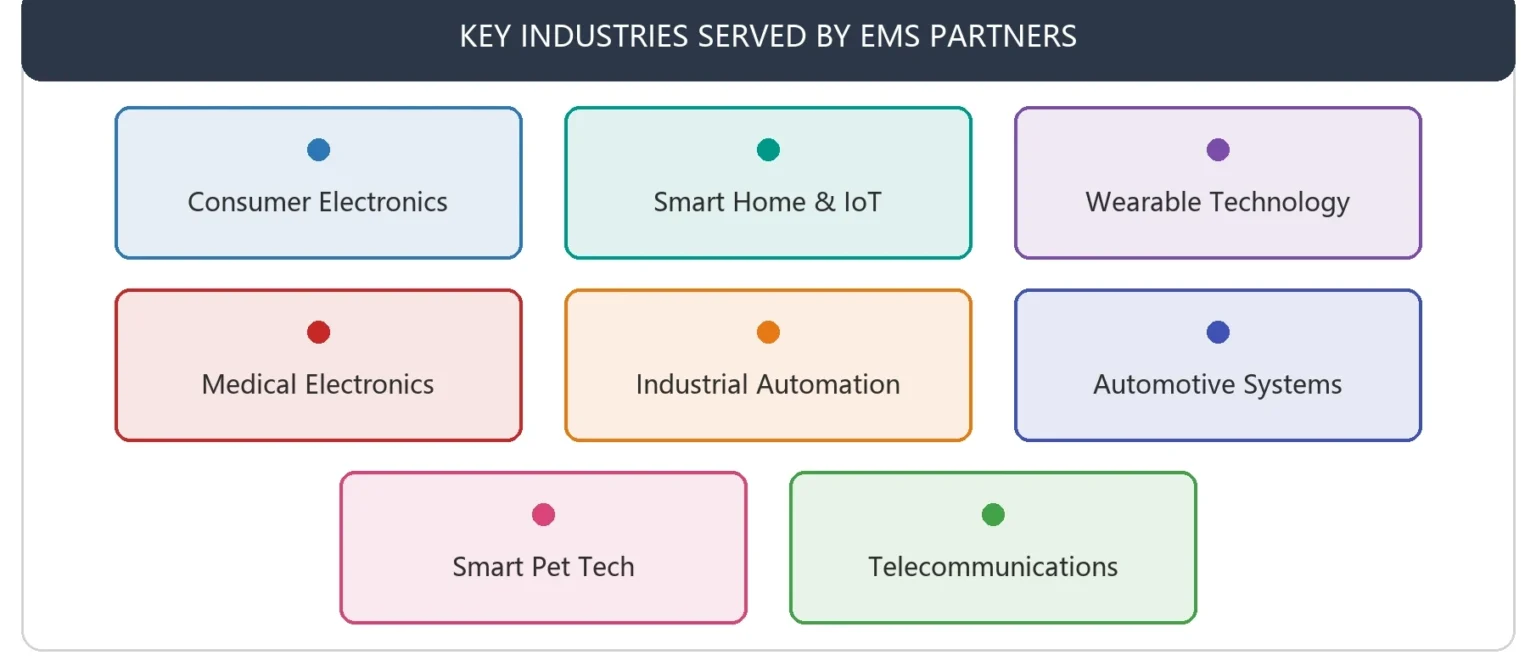
Electronic manufacturing services power products across diverse commercial and consumer markets.
Consumer Electronics
High-volume personal gadgets demand strict quality control, rapid assembly times, and aggressive unit-cost targets. Factories utilize high-speed assembly and automated packaging lines to handle millions of devices per month.
Smart Home & IoT Devices
Scale matters in IoT device manufacturing. Products like wireless environmental sensors, connected smart locks, and energy monitors require precise wireless calibration, low-power optimization, and reliable mass-scale sensor integration.
Wearable Technology
Compact form factors drive wearable device manufacturing. Building fitness trackers and smart rings requires high-density flex-circuit PCB assembly, miniaturized surface mount technology, precise battery potting, and water-resistance testing.
Medical Electronics
Life-critical health monitors and diagnostic tools demand extreme reliability. Medical production runs require strict ISO 13485 cleanroom assembly, complete lot traceability, and comprehensive validation documentation.
Industrial Automation
Industrial hardware operates in harsh factory environments. EMS providers apply protective conformal coatings, heavy-duty through-hole wiring, and ruggedized enclosures to safeguard motor controllers, programmable logic controllers (PLCs), and edge computers.
Automotive Electronics
Automotive systems face extreme temperature swings and constant mechanical vibration. Manufacturing automotive sensors, battery management systems (BMS), and telematics controllers requires IPC Class 3 soldering and zero-defect quality controls.
Smart Pet Technology
The pet hardware sector relies heavily on smart device manufacturing. Products like GPS pet trackers, automated health-monitoring feeders, and smart toys demand durable water-resistant enclosures and long battery runtimes.
Telecommunications Equipment
High-bandwidth communication infrastructure demands clean signal integrity. Assembling 5G base stations, enterprise routers, and satellite receivers requires multi-layer RF circuit board layout capabilities and specialized RF shielding.
Why Businesses Outsource Electronic Manufacturing Services
Outsourcing production to a dedicated ems contract manufacturing facility offers structural, financial, and technical advantages over operating an in-house factory.
Faster Time to Market
Partnering with an established electronics manufacturing partner eliminates the months required to set up factory space, buy pick-and-place lines, and hire assembly technicians. Established facilities start pilot runs immediately using existing infrastructure.
Lower Manufacturing Costs
Contract facilities achieve economies of scale by purchasing passive components, silicon chips, and raw materials across dozens of client accounts. This aggregated volume yields component pricing unattainable by single product startups.
Access to Specialized Engineering
A seasoned contract electronics manufacturer employs teams of mechanical, electrical, firmware, and quality engineers. Clients gain access to specialized design and process engineering expertise without maintaining heavy internal payroll.
Reduced Supply Chain Risks
Navigating global component markets requires deep vendor connections. Established EMS companies maintain direct ties with global semiconductor foundries, authorized distributors, and local raw material suppliers to navigate market shocks.
Better Product Quality
Dedicated assembly facilities invest heavily in optical inspection, X-ray inspection for BGA chips, environmental burn-in chambers, and automated testing rigs. These investments yield low defect rates and long product lifespans.
Scalable Manufacturing Capacity
Outsourcing provides flexible manufacturing scalability. A business can start with a 1,000-unit pilot run and ramp smoothly up to 500,000 units per year without changing primary facility partners or rewriting quality procedures.
EMS vs OEM vs ODM: Understanding the Differences
Choosing between contract manufacturing models determines where IP ownership, engineering responsibility, and production risks sit.
What EMS Means
Under an EMS electronic manufacturing model, the client retains complete intellectual property ownership. The EMS company executes manufacturing, testing, and logistics based on the client’s custom design files, bill of materials, and mechanical drawings.
How OEM Manufacturing Works
In OEM electronics manufacturing, the client brand designs the proprietary product from scratch. The client then hires an OEM factory partner to build the physical device precisely according to those custom blueprints and engineering files.
What ODM Manufacturing Includes
In ODM electronics manufacturing, the factory owns pre-engineered white-label product designs. Clients select an existing base platform, apply custom branding, make minor housing adjustments, and launch products rapidly without starting from scratch.
Which Manufacturing Model Fits Your Business?
- Choose EMS or OEM if you are launching proprietary hardware requiring custom circuit boards, specialized enclosure molds, and unique software integration.
- Choose ODM if you need a quick-to-market solution using established, off-the-shelf hardware designs with simple logo rebranding.
What Makes a Great EMS Manufacturing Partner?
Selecting an electronic manufacturing company shapes your long-term product profitability and market reputation.
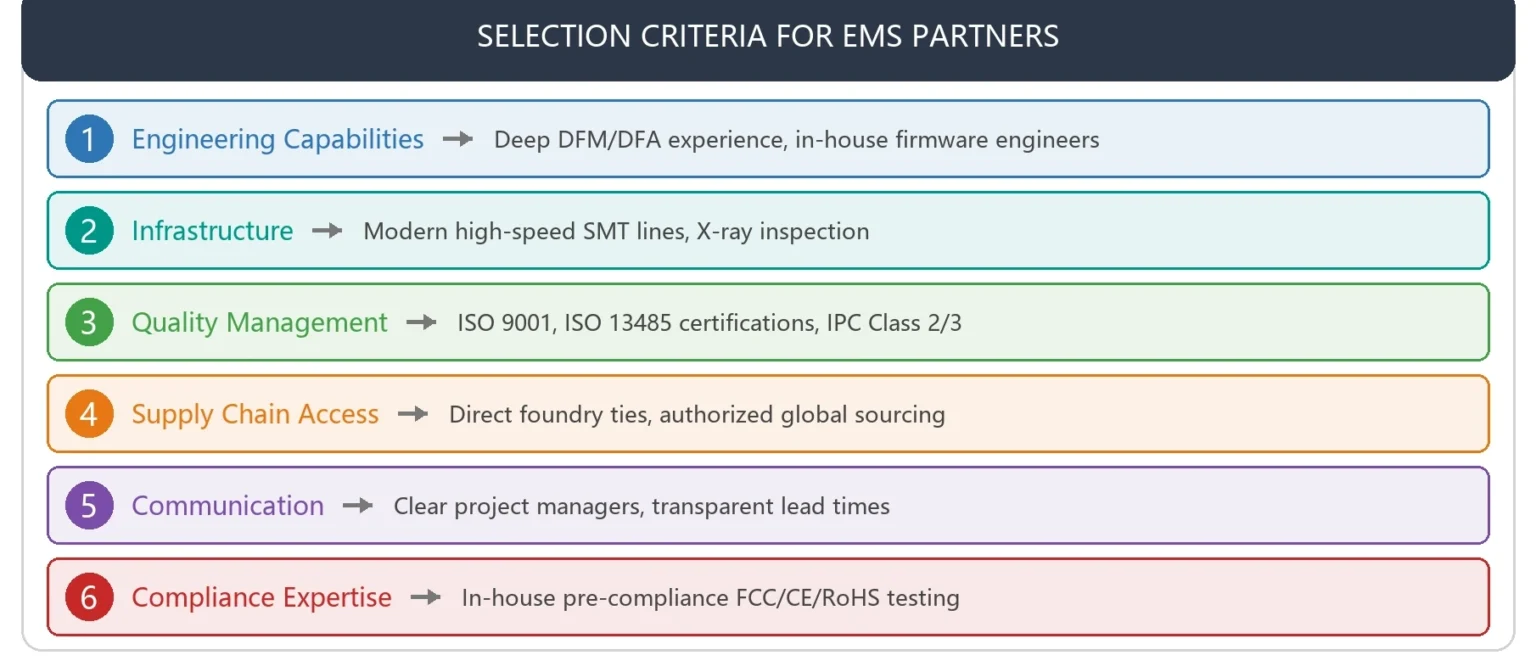
Engineering Capabilities
Evaluate the factory’s design capabilities. Look for experienced hardware, PCB layout, and mechanical engineers who provide deep design for manufacturability feedback long before production lines start.
Manufacturing Infrastructure
Inspect the factory’s physical machinery. Modern facilities maintain dual-lane SMT lines, automated optical inspection systems, 3D X-ray inspection for fine-pitch BGA packages, and environmental testing chambers.
Quality Management Systems
Confirm the manufacturing partner holds recognized certifications. Quality management systems guarantee consistent component handling, ESD-safe workstations, operator training, and rigorous lot tracking.
Supply Chain Reliability
A strong electronics manufacturing partner maintains direct partnerships with top semiconductor vendors and global distributors. This ensures priority allocation during global chip shortages and protects against counterfeit components.
Communication & Project Management
Hardware development requires transparent project tracking. Work with partners who assign dedicated English-speaking project managers and provide weekly engineering status updates, detailed build reports, and clear cost breakdowns.
Global Compliance Experience
Bringing electronics to market requires navigating international regulatory approvals. Choose a facility experienced in designing for and executing CE Certification, FCC Certification, UL Certification, and RoHS Compliance.
Quality Standards Every EMS Company Should Meet
Regulatory compliance and rigorous industry standards guarantee hardware safety, reliability, and international legal compliance.
IPC Manufacturing Standards
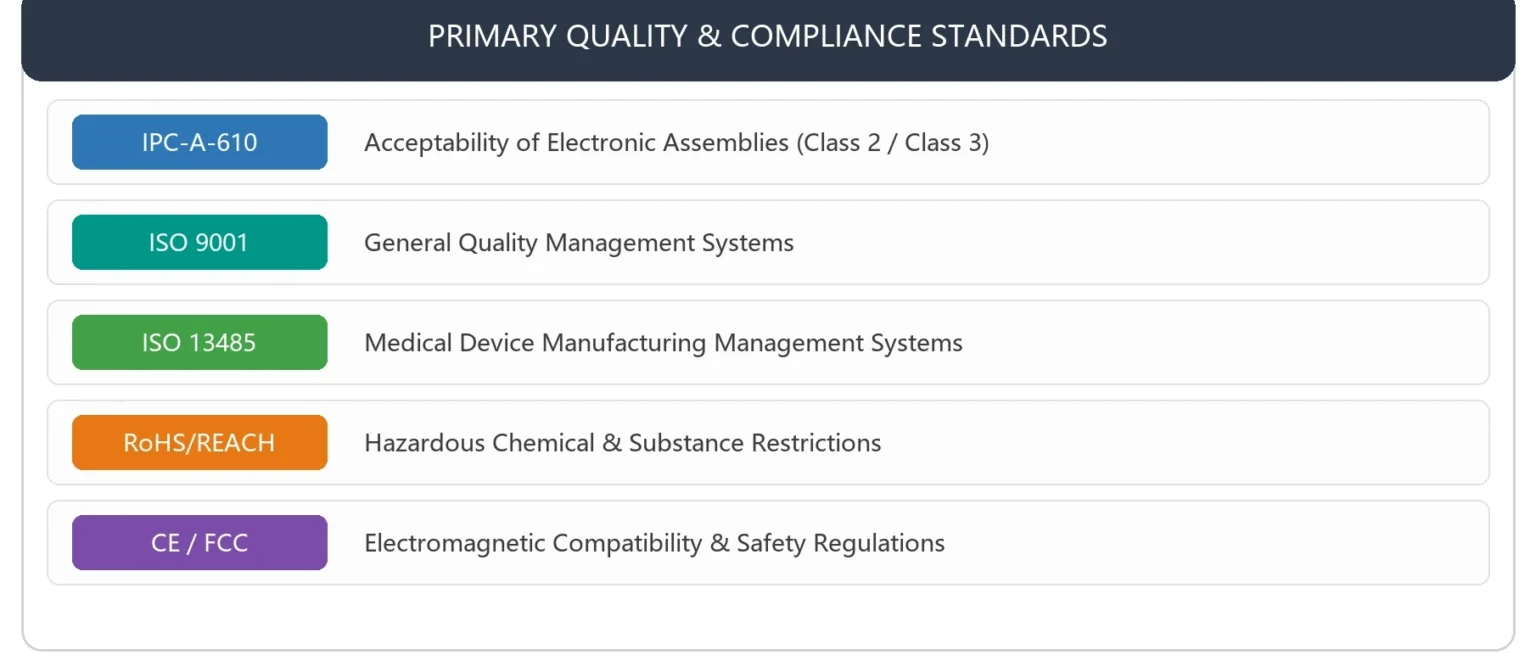
IPC Standards define assembly quality across the electronics industry. Ensure your partner builds to IPC-A-610 Class 2 for general consumer electronics or IPC-A-610 Class 3 for high-reliability medical, aerospace, and industrial devices.
ISO Certifications
- ISO 9001: Validates core quality management standards across manufacturing processes.
- ISO 13485: Specifies strict quality requirements for medical device manufacturing.
RoHS & REACH Compliance
RoHS Compliance guarantees that circuit boards and enclosures contain no hazardous materials such as lead, mercury, or cadmium. REACH regulates environmental safety regarding chemical substances used during production.
CE, FCC & Other Regulatory Requirements
- FCC Certification: Mandatory for devices sold in the United States to ensure electromagnetic interference remains within safe limits.
- CE Certification: Required for products sold in the European Economic Area to certify health, safety, and environmental protection compliance.
- UL Certification: Ensures electrical and fire safety for mains-powered consumer and industrial devices.
Traceability & Documentation
Full material traceability assigns unique QR codes or barcodes to every assembled board. If a component batch fails in the field, factory records immediately identify every affected unit by serial number.
Common Challenges in Electronic Manufacturing
Hardware development carries inherent production risks that require proactive management.
Component Shortages
Semiconductor market fluctuations cause unexpected component shortages. A single out-of-stock resistor or microcontroller can freeze an entire production line if drop-in alternatives are not planned in advance.
Design for Manufacturability Issues
Flawed PCB layouts create severe production bottlenecks. Unreachable solder pads, inadequate trace spacing, or bad thermal relief cause bridges, tombstones, and high defect rates during reflow soldering.
Production Delays
Delays happen when supply chain planning misses component lead times or when prototype bugs remain unresolved prior to launching new product introduction manufacturing lines.
Quality Control Risks
Without automated inspection, cold solder joints, misplaced chips, or un-soldered pins reach final assembly, causing high return rates and damage to brand reputation.
Supply Chain Disruptions
Global shipping bottlenecks, geopolitical shifts, and raw material cost spikes disrupt product delivery timelines if your manufacturing team lacks regional component sourcing flexibility.
Product Compliance Challenges
Failing formal FCC or CE emissions testing late in the development cycle forces costly board re-layouts and delays product market launches by months.
How EMS Companies Reduce Manufacturing Risks
Professional contract assembly teams deploy clear engineering frameworks to catch defects early and guarantee production stability.
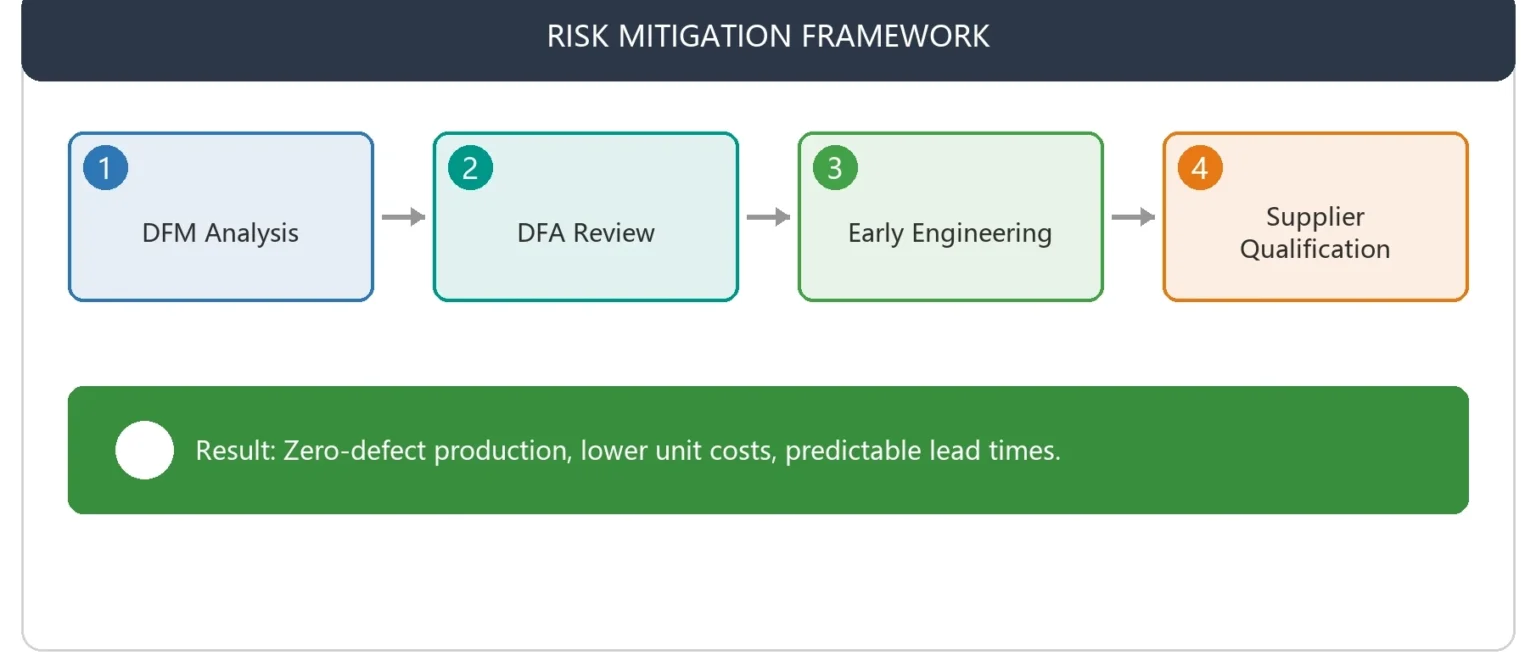
Design for Manufacturing (DFM)
Engineers perform comprehensive DFM reviews before fabricating bare circuit boards. DFM identifies trace routing errors, confirms copper weights, and checks component footprint geometries against IPC rules.
Design for Assembly (DFA)
DFA focuses on reducing assembly labor time. Engineers simplify mechanical enclosure fits, reduce screw counts, standardize fastener sizes, and streamline internal cable assembly runs to lower assembly error rates.
Early Engineering Reviews
Conducting multi-disciplinary engineering reviews early in hardware development catches circuit errors while design changes remain inexpensive.
Supplier Qualification
Leading factories enforce strict factory audit procedures. They vet raw material suppliers, test incoming passive components for authenticity, and maintain secondary vendor sources for every critical BOM item.
Pilot Production Validation
Before launching full-scale runs, factories execute structured validation builds:
| Stage | Focus | Typical Volume |
|---|---|---|
| EVT | Functional validation, board layout fixes | 10 – 50 units |
| DVT | Enclosure fit, thermal/drop tests, CE/FCC | 50 – 200 units |
| PVT | Factory line speed, tool yield validation | 500 – 1,000 units |
Continuous Quality Improvement
Factories track real-time yield data at every workstation. Using Statistical Process Control (SPC), engineers spot minor solder paste drift or component alignment errors immediately, fixing issues before defects multiply.
Understanding the Cost of EMS Manufacturing
Accurately modeling manufacturing budgets prevents unexpected cash flow bottlenecks during product rollouts.
Factors That Affect Manufacturing Costs
Prototype vs Mass Production Pricing
Prototypes cost significantly more per unit due to manual line setup times, low-volume PCB fabrication runs, and component sample premiums. Mass production services drop unit costs substantially by spreading setup fees across tens of thousands of units.
How to Optimize Manufacturing Budgets
To minimize per-unit costs:
Questions to Ask Before Choosing an EMS Company
Asking pointed engineering questions during vendor evaluation separates top-tier manufacturing partners from simple board assemblers.
Engineering & Design Questions
- Do you perform in-house DFM and DFA checks on design files before starting production?
- What experience does your engineering team have with our specific product category (e.g., IoT device manufacturing or RF design)?
Manufacturing Capability Questions
- What is the smallest component footprint your high-speed SMT lines can place reliably?
- Do you offer full box build assembly, internal wire harnessing, and custom retail packaging integration?
Supply Chain Questions
- How do you verify component authenticity and guard against counterfeit semiconductors?
- What strategies do you deploy to manage long-lead components and global supply chain bottlenecks?
Quality Assurance Questions
- Are your facilities certified to ISO 9001 and ISO 13485 standards?
- What automated inspection systems (AOI, SPI, 3D X-Ray) do you use on active SMT lines?
Delivery & Support Questions
- What are your standard lead times for prototype manufacturing versus volume runs?
- How do you handle engineering change orders (ECOs) and post-production field repairs?
Related: OEM Manufacturing Explained: Everything Businesses Need to Know (2026)
Why Businesses Choose Precintl for EMS, ODM & OEM Manufacturing
Finding a reliable hardware partner is essential for commercial success. Precintl provides complete hardware execution, helping brands take hardware projects from initial design to global mass production.
End-to-End Product Development
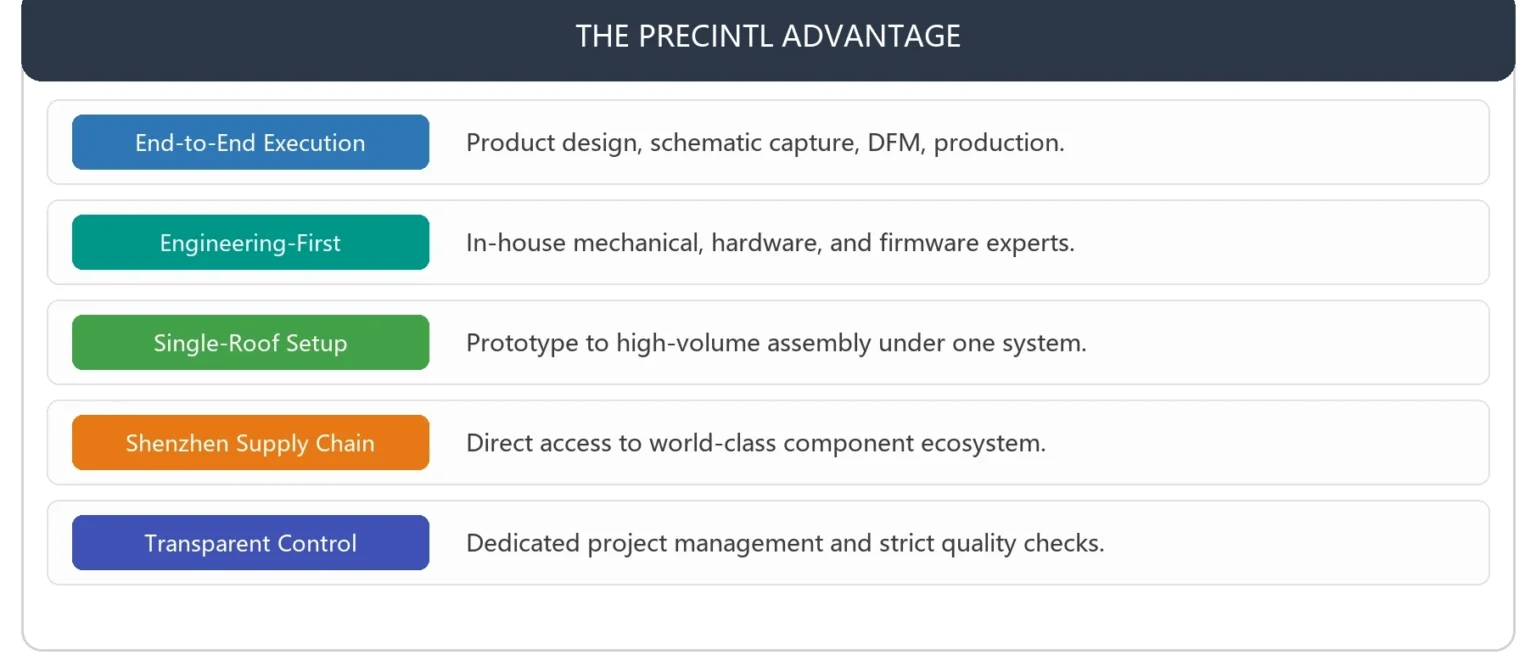
Precintl manages the entire hardware lifecycle. Our teams deliver product design services, industrial design, mechanical engineering, custom pcb design, and full turnkey electronic manufacturing. This eliminates friction between separate design agencies and factories.
Engineering-First Manufacturing Approach
We prioritize process engineering from day one. Our engineering-first methodology runs detailed DFM and DFA analysis during early schematics, catching potential layout errors early to keep production running smoothly.
Prototype to Production Under One Roof
Precintl offers seamless scaling. We handle initial electronic prototyping, manage low volume electronics manufacturing for market validation, and transition products into high volume electronics manufacturing without requiring vendor handoffs.
Global Supply Chain Expertise
Leveraging deep industry ties and strategic Shenzhen manufacturing integration, Precintl secures priority component sourcing, high-grade materials, and rapid product sourcing at competitive price points.
Transparent Project Management
We eliminate supply chain opacity. Clients receive clear timelines, structured build reports, direct access to project managers, and transparent bill-of-materials cost breakdowns throughout every phase of production.
Scalable Manufacturing for Growing Businesses
Whether you need custom electronics manufacturing for niche industrial tools, smart device manufacturing, or wearable device manufacturing, Precintl scales manufacturing capacity to support your brand’s growth trajectory. Explore Precintl’s manufacturing capabilities to learn more about our hardware development and production services, or contact Precintl to discuss your next manufacturing project.
The Future of Electronic Manufacturing Services
Technological advancements continue to improve precision, speed, and visibility across the electronic manufacturing industry.
AI-Assisted Manufacturing
Artificial intelligence powers modern optical inspection systems. Machine learning models analyze solder joint geometry in real time, detecting micro-defects faster and more accurately than traditional manual inspections.
Smart Factories & Industry 4.0
Smart factories utilize IoT sensors across SMT machines, reflow ovens, and testing stations. Automated systems track line speeds, monitor machine health, and adjust solder temperatures dynamically to maintain optimal yields.
Sustainable Electronics Manufacturing
Environmental regulations and consumer expectations drive greener manufacturing practices. Facilities adopt lead-free soldering, recyclable packaging materials, energy-efficient reflow ovens, and eco-friendly waste management processes.
Digital Supply Chain Management
Cloud-integrated supply chain platforms provide real-time component tracking. Product managers track material lead times, component prices, and inventory levels across global warehouses from unified digital dashboards.
Increasing Demand for Connected Devices
The growth of smart home technology, industrial IoT, and connected automotive systems drives demand for high-density, low-power PCB assembly services. EMS partners continue to innovate, supporting smaller chip packages and dense flex-circuit assemblies.
Final Thoughts
Bringing a complex electronic product to market demands technical precision, reliable component sourcing, and rigorous quality control. Partnering with a proven electronic manufacturing services company ensures your hardware transitions smoothly from early schematics to high-volume commercial production.
Ready to launch your next hardware product or optimize your current manufacturing process? Contact the engineering team at Precintl today to discuss your product design and manufacturing requirements.
Frequently Asked Questions
What does electronics manufacturing do?
Electronics manufacturing handles the physical fabrication, assembly, testing, and distribution of electronic hardware. This includes building printed circuit boards (PCBs), populating microchips via Surface Mount Technology (SMT), assembling enclosures (Box Build), running functional tests, and managing global shipping logistics for client companies.
Who is the world’s largest electronics manufacturer?
Foxconn (Hon Hai Precision Industry) is currently the world’s largest contract electronics manufacturer, assembling products for top global technology brands across massive manufacturing facilities worldwide.
What is the difference between EMS, OEM, and ODM?
- EMS (Electronic Manufacturing Services): The factory builds, tests, and ships custom hardware designed entirely by the client brand.
- OEM (Original Equipment Manufacturer): The client owns proprietary designs and hires a specialized factory to manufacture products to exact engineering specifications.
- ODM (Original Design Manufacturer): The factory creates and owns pre-engineered white-label hardware platforms that clients customize with basic branding before selling.
What services do EMS companies provide?
EMS companies provide end-to-end hardware development services, including hardware engineering, PCB design, prototype manufacturing, component sourcing, SMT and through-hole PCB assembly, cable assembly, box build assembly, regulatory certification testing (FCC/CE), packaging, and after-sales repair services.
Why do companies outsource electronic manufacturing services?
Companies outsource electronic manufacturing to eliminate expensive capital investments in factory machinery, reduce unit production costs through supplier economies of scale, access specialized engineering talent, compress product launch timelines, and focus internal resources on product software, marketing, and sales growth.