Understanding MOQ manufacturing helps you optimize costs and manage cash flow. Learn how minimum order quantity works, how to negotiate, and pick the right manufacturing partner. Contact Precintl today for tailored product development!
What Is MOQ in Manufacturing?
MOQ Meaning and Definition for Manufacturers and Buyers
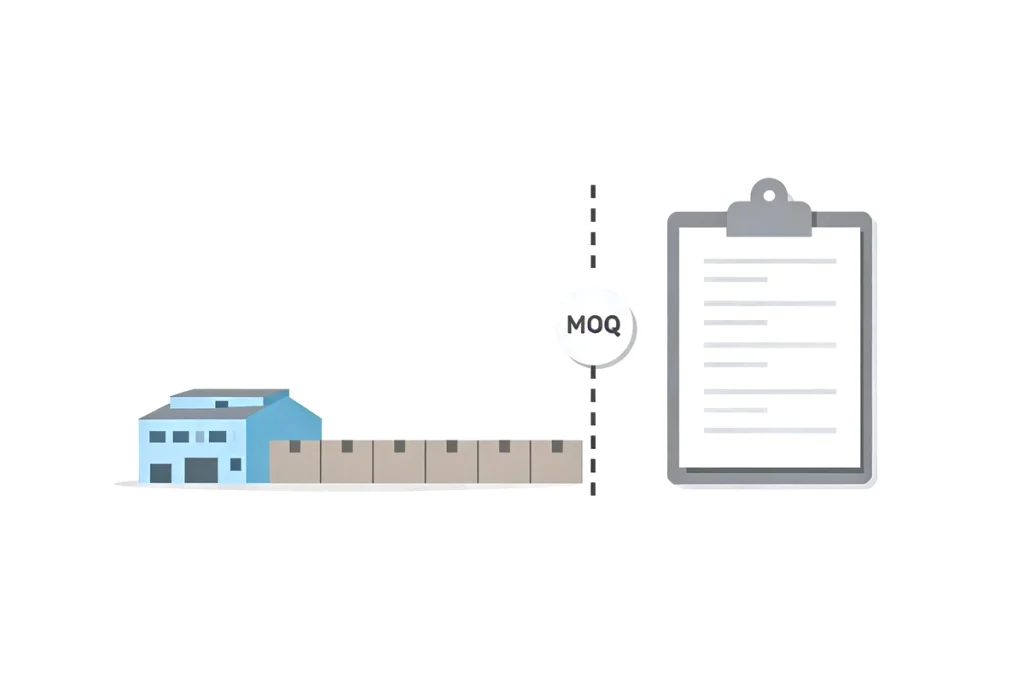
MOQ meaning in manufacturing refers to the fewest number of units a supplier agrees to produce in a single production run. For hardware brands, understanding MOQ meaning helps set realistic procurement strategies. When a factory sets an MOQ requirement, it establishes a baseline where setup costs, material purchases, and operational overhead break even.
For buyers, MOQ meaning in business represents the initial inventory commitment needed to kick off production. If a factory specifies an MOQ requirement of 1,000 units, they will not process orders below that figure without price adjustments.
Why Manufacturers Set a Minimum Order Quantity
Factories do not impose an MOQ supplier requirement arbitrarily. Every manufacturing run involves fixed overheads—machine calibration, line reset, worker scheduling, and material minimums from raw component vendors.
If a factory operates a line for 50 units, the setup time and labor waste eliminate any profit margin. Establishing MOQ for manufacturers guarantees that production volume covers operational baselines while maintaining predictable factory utilization.
How MOQ Differs From Production Capacity and Batch Size
Buyers often confuse minimum order quantity manufacturing with production capacity or batch size. These terms cover different aspects of factory management:
- Production Capacity: The maximum output a factory can yield within a specific timeframe (e.g., 50,000 units per month).
- Manufacturing Batch Size: The number of items produced together in one continuous run before tooling is changed or recalibrated.
- Minimum Order Quantity: The threshold of units required for a commercial contract to make business sense.
Related: EMS Electronic Manufacturing Explained: From Design to Mass Production (2026)
How Does MOQ Work in Manufacturing?
What Happens When a Buyer Orders Below the MOQ?
Ordering below the minimum production run limits standard factory operations. When a client requests orders beneath the stated MOQ requirement, manufacturers typically offer three paths:
- Unit Price Adjustments: Increasing the per-unit cost to absorb fixed setup overhead over fewer products.
- Order Rejection: Direct refusal if raw component suppliers enforce strict purchase thresholds that the factory cannot bypass.
- Surcharge Fees: Charging a flat “small batch penalty” or line setup fee while keeping base unit costs constant.
MOQ vs. Prototype, Pilot Production, and Mass Production
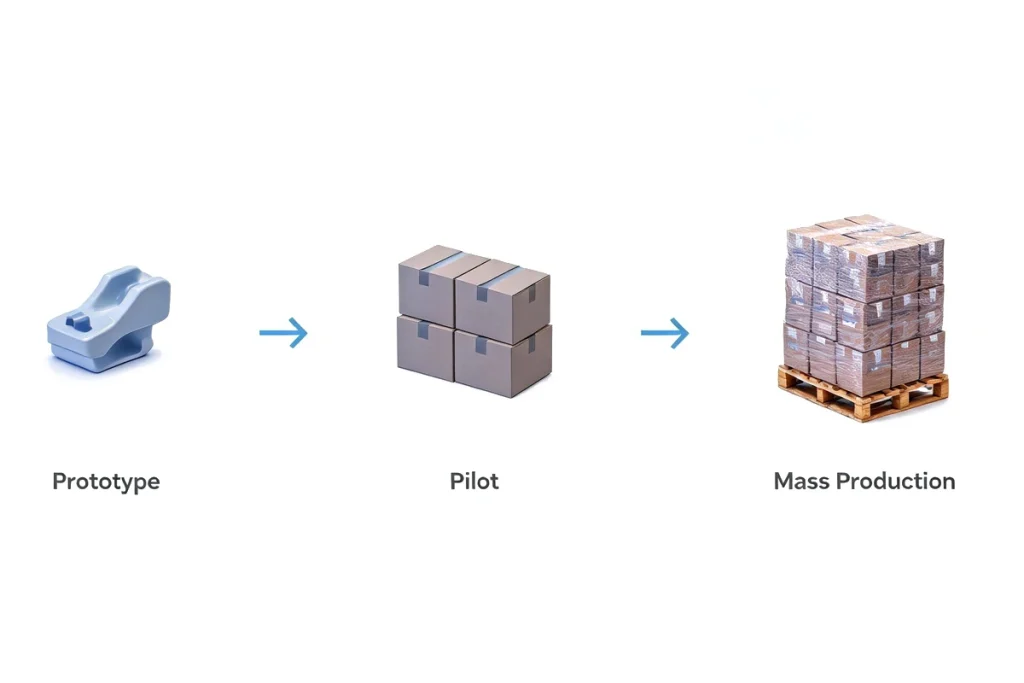
Minimum thresholds change depending on where a hardware item sits in its product life cycle:
| Stage | Volume Expectation | Objective | MOQ Impact |
| Prototype vs MOQ | 1 – 10 units | Design validation & functional testing | Zero MOQ; high fixed engineering cost |
| Pilot Production | 50 – 500 units | DFM verification & yield checking | Low MOQ; elevated unit costs |
| MOQ for Mass Production | 1,000+ units | Commercial scale & cost optimization | Full factory MOQ applied |
When MOQ Is Established During the Product Development Process
A clear understanding of product development MOQ develops during the Design for Manufacturability (DFM) phase. Early mechanical and electronic architecture choices dictate raw component minimums. Establishing these numbers prior to tooling fabrication prevents cash flow surprises before entering full production.
How Do Manufacturers Calculate MOQ?
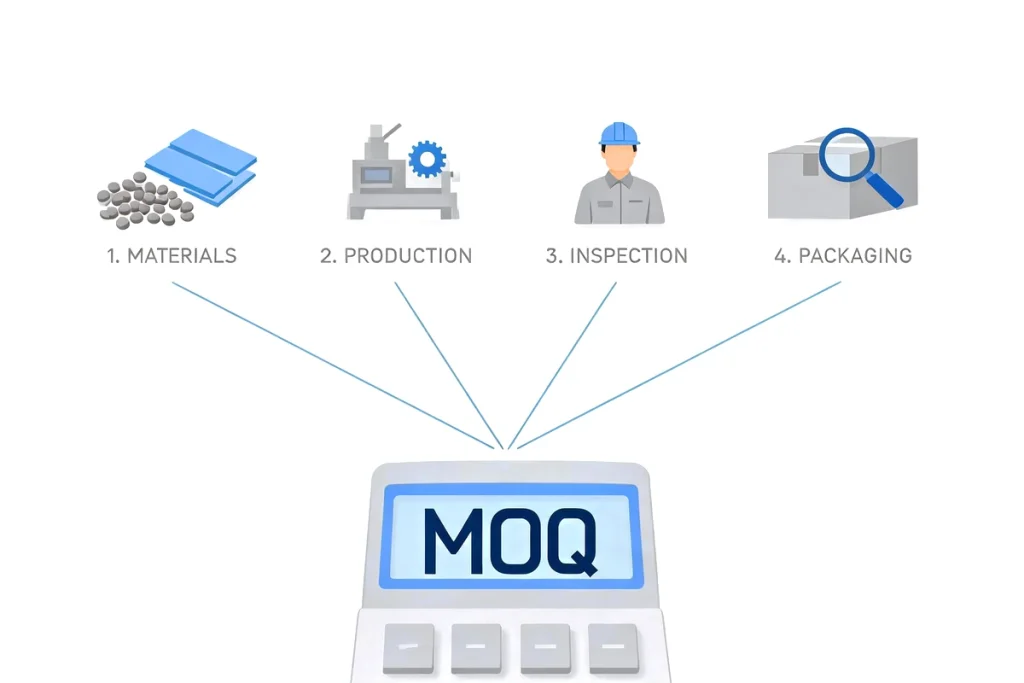
| Calculation Step | Included Cost Factors & Description |
| 1. Base Manufacturing Costs | Raw Material Purchases + Line Setup / Tooling + Labor / Overhead + Packaging & Quality Control |
| ↓ | |
| 2. Financial Assessment | Target Profit Margin & Breakeven Threshold |
| ↓ | |
| 3. Final Output | FINAL MINIMUM ORDER QUANTITY (MOQ) |
Material and Component Purchasing Requirements
A primary factor in how manufacturers determine MOQ lies further up the supply chain. Chipmakers, plastic resin distributors, and metal fabricators impose raw material minimum order quantity cost thresholds. A factory cannot offer a 500-unit build if the specialized Integrated Circuit (IC) requires a minimum reel size of 3,000 units.
Tooling, Setup, and Production Line Costs
Configuring an SMT (Surface Mount Technology) assembly line or preparing custom injection molds takes hours of manual labor and machine downtime. These fixed setup costs must be distributed across the manufacturing batch size. Small runs force high overhead onto every individual product.
Labor, Machine Utilization, and Manufacturing Overhead
Factories earn revenue by optimizing machine usage and floor space. Running small batches creates line switching, increases error rates during startup phases, and leaves machinery idle. Higher MOQ requirements ensure optimal machine efficiency and predictable yield rates.
Packaging, Testing, and Quality Control Requirements
Custom retail packaging, localized user manuals, and specialized quality assurance jigs require dedicated setups. Printing custom packaging boxes often carries a distinct minimum threshold (frequently 2,000+ units) separate from the core product build.
Economies of Scale and Production Volume
As production volume scales, fixed factory overhead spreads across more items, driving down individual manufacturing costs. This financial efficiency represents the core driver behind high MOQ manufacturing strategies.
What Factors Affect Manufacturing MOQ?
Product Complexity and Design Requirements
Simple mechanical assemblies with off-the-shelf enclosures yield lower thresholds. Complex electro-mechanical products demand rigid assembly protocols, driving factors that affect MOQ upward.
Bill of Materials and Component Availability
A Bill of Materials (BOM) containing rare, single-source electronic components raises minimums. If a component vendor sets strict order floors, those restrictions pass directly down to the primary brand.
Custom Tooling and Manufacturing Processes
Products using custom injection molds, specialized CNC fixtures, or proprietary aluminum extrusions demand larger commitments to amortize tooling expenses.
Product Customization and Branding Requirements
Adding custom color treatments, silkscreen logos, or specialized surface coatings increases minimum thresholds. Plain black, unbranded housings allow factories to consolidate builds with other clients, reducing minimum production run friction.
Supplier Production Capacity and Lead Time
Large-scale factories running multi-million-unit lines prioritize clients offering substantial volume commitments. Smaller manufacturing facilities with agile lines handle low MOQ manufacturing with more flexibility.
Target Market and Expected Order Volume
Planning procurement around target sales velocity ensures inventory matches market uptake, preventing cash flow bottlenecks caused by excess stock.
MOQ in OEM and ODM Manufacturing
What Is OEM MOQ?
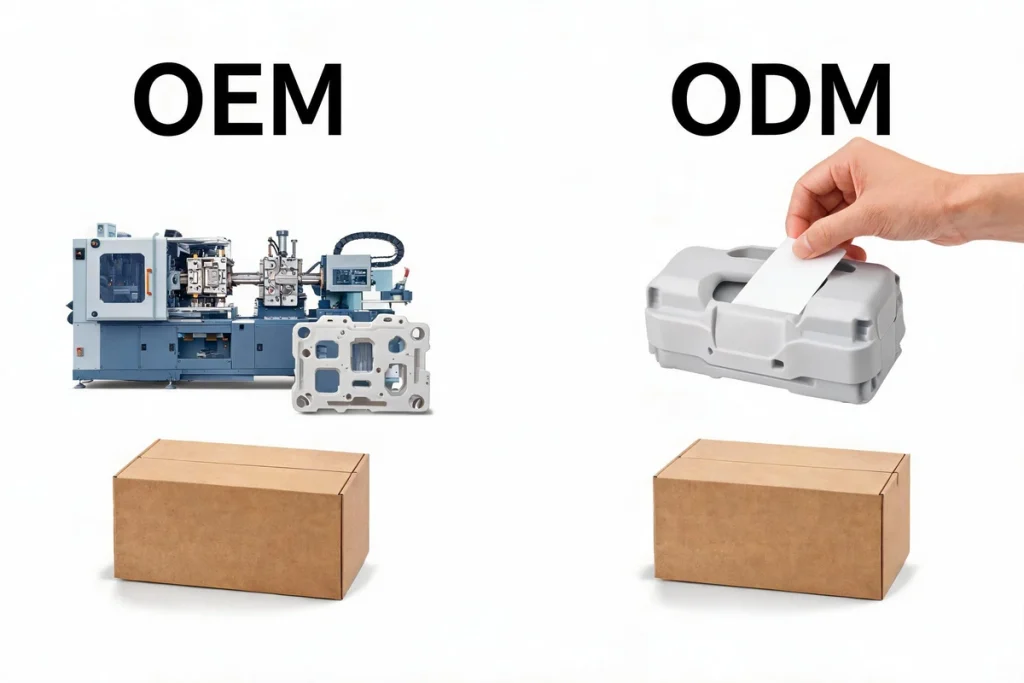
An OEM MOQ applies when building fully customized, client-designed hardware from the ground up. Original Equipment Manufacturer builds involve dedicated tooling, proprietary PCBs, and bespoke enclosures, driving elevated supplier minimum order quantity thresholds.
What Is ODM MOQ?
An ODM MOQ covers pre-designed, off-the-shelf base products customized with client branding or minor cosmetic adjustments. Original Design Manufacturer paths allow lower thresholds because internal architectures and tooling exist.
OEM vs. ODM MOQ Requirements
| Attribute | OEM Manufacturing MOQ | ODM Manufacturing MOQ |
| Tooling Investment | High (Custom Molds) | Low to None (Existing Molds) |
| Development Lead Time | Long (6–12 months) | Short (1–3 months) |
| Component Flexibility | Complete control | Limited to pre-certified options |
| Typical Order Floor | Higher (1,000 – 5,000+ units) | Lower (300 – 1,000 units) |
How Product Design Influences OEM and ODM MOQ
Designing unique internal geometries drives customized requirements higher. Choosing pre-engineered ODM platforms allows hardware brands to launch products with lower financial hurdles.
Related: OEM vs ODM Manufacturing: Which Is Right for Your Product?
MOQ for Custom Products and Electronics Manufacturing
Why Custom Electronics Often Have Higher MOQs
Electronics manufacturing MOQ is dominated by semiconductor supply chains. Silicon foundries, passives distributors, and display panel fabricators sell components in fixed reel sizes or tray quantities.
PCB, Components, Enclosures, and Assembly Considerations
- Printed Circuit Board (PCB): Raw PCB fabricators price by board panelization. Smaller runs create material waste on standard panel sizes.
- Passive Components: Resistors and capacitors arrive on reels of 5,000 to 10,000 pieces.
- Enclosures: Plastic injection molding machine setups require substantial raw material purging during temperature calibration.
How Component MOQ Can Affect the Finished Product MOQ
If a single critical micro-controller has an order floor of 2,000 units, the finished custom product MOQ defaults to that ceiling unless the buyer pays for excess component inventory.
MOQ Considerations for Smart Devices and Connected Products
Smart connected hardware requires RF certification (FCC, CE), specialized wireless testing fixtures, and pre-flashed firmware. These additional steps raise setup costs, driving up initial production requirements.
MOQ for Startups and Small Businesses
| Strategy Comparison | Low MOQ Strategy | High MOQ Strategy |
| Unit Cost | Higher per-unit cost | Lower per-unit cost |
| Capital Impact | Preserves working capital | Depletes initial capital |
| Inventory Risk | Minimizes unsold inventory risk | Maximizes inventory risk |
| Optimal Path | Pilot Run → Market Validation → Scale Mass Production |
Why MOQ Matters When Launching a New Product
For early-stage companies, MOQ for startups directly dictates capital allocations. Committing limited capital to bulk physical inventory leaves sparse resources for software integration, compliance certifications, or market deployment.
How to Balance MOQ, Unit Cost, and Inventory Risk
Achieving profitability requires balancing inventory risk against margin targets:
$$\text{Total Capital Exposure} = (\text{Order Quantity} \times \text{Unit Cost}) + \text{Inventory Holding Costs}$$
Selecting an excessively high order floor drops the unit price, but locking up capital in slow-moving stock increases inventory costs and holding risks.
Strategies for Managing MOQ With Limited Initial Demand
- Phase orders through scheduled releases rather than receiving all stock at once.
- Pay component buffer fees to allow the supplier to store long-lead chips while assembling finished goods on demand.
- Limit initial product SKUs to a single finish or colorway.
When a Higher MOQ Can Actually Reduce Product Costs
If customer demand is proven, opting for a higher MOQ and wholesale pricing yields significant per-unit savings. Spreading fixed mold charges over larger production runs dramatically improves gross profit margins.
Low MOQ vs. High MOQ Manufacturing
Advantages and Disadvantages of Low MOQ
Operating with lower minimums offers clear trade-offs:
- Pros: Preserves cash flow, reduces warehousing overhead, enables rapid design iterations, limits product obsolescence.
- Cons: Higher per-unit price, elevated shipping costs per item, lower priority queue status with factories.
Advantages and Disadvantages of High MOQ
Large production batches present opposite conditions:
- Pros: Optimal per-unit pricing, lower unit shipping costs, secured factory production slots, higher profit margins at scale.
- Cons: Ties up operating capital, creates inventory holding risks, increases vulnerability to unexpected design flaws.
How MOQ Impacts Unit Cost and Profit Margins
The relationship between MOQ and unit cost follows an inverse curve. Beyond a specific output point, efficiency gains plateau due to baseline material limits.
| Production Scale | Volume Tier | Unit Cost Impact | Business Trade-off |
| Low MOQ | Small Batch | High Unit Cost | Maximizes Cash Flow Agility |
| Balanced Point | Medium Batch | Moderate Unit Cost | Optimal Risk/Reward Balance |
| High MOQ | Mass Production | Lowest Unit Cost | Maximizes Profit Margins at Volume |
Choosing the Right MOQ for Your Business
Match manufacturing order requirements directly to cash reserves, sales velocity, and product risk profiles. Startups must prioritize financial agility over minor unit cost reductions.
How to Negotiate MOQ With a Manufacturer
Questions to Ask a Manufacturer About MOQ
Before signing a contract, clarify these procurement details with your supplier:
- “What specific component or raw material is driving the current minimum threshold?”
- “What is the cost differential if we order 500 units versus 2,000 units?”
- “Can we order packaging separately or utilize standard factory boxing?”
- “Is it possible to pay a line setup fee in lieu of meeting full volume requirements?”
Negotiating MOQ for a New Product
When engaging in MOQ negotiation with manufacturers, avoid demanding arbitrary discounts. Address the factory’s root financial concerns:
- Offer to cover raw material minimum costs upfront while assembling finished goods in smaller batches.
- Agree to a price tier schedule that scales unit costs down as annual order volumes increase.
Using Pilot Production to Validate Demand Before Scaling
Propose a formal pilot production run. Frame this smaller initial build as a necessary quality and process validation run prior to committing to full mass production.
How Forecasting and Repeat Orders Can Improve MOQ Terms
Factories value long-term stability. Providing a realistic 12-month rolling forecast demonstrates business maturity, encouraging suppliers to offer flexible initial order floors.
How to Reduce Manufacturing MOQ
Simplify Product Design and Customization
Fewer unique components mean simpler assembly setups. Designing products using standard hardware dimensions significantly lowers manufacturing hurdles.
Use Standard Components and Existing Tooling
Eliminate custom plastic enclosures by using off-the-shelf housings. Selecting readily available microcontrollers avoids single-source component minimums.
Consolidate Components and Production Requirements
Standardize screw sizes, internal cabling, and surface finishes across your entire product line to achieve shared component minimums.
Start With a Pilot Run Before Mass Production
Running an initial 200-unit pilot batch validates line assembly yields and confirms quality standards while keeping early capital investments manageable.
Build a Long-Term Manufacturing Plan
Demonstrating clear engineering progress and sales roadmaps turns suppliers into strategic partners who willingly share inventory risks.
MOQ vs. Other Manufacturing Terms
MOQ vs. EOQ: What Is the Difference?
While MOQ is set by the supplier (minimum output limit), Economic Order Quantity (EOQ) is calculated by the buyer to determine optimal inventory purchasing volumes based on demand and storage fees.
MOQ vs. MOV: Minimum Order Value Explained
MOQ specifies a physical count of units. Minimum Order Value (MOV) requires a dollar amount threshold (e.g., $5,000 minimum order spend), allowing buyers to mix and match different product SKUs.
MOQ vs. MPQ: Minimum Packaging Quantity
Minimum Packaging Quantity (MPQ) represents how products are boxed for transport (e.g., 50 units per master carton). Orders typically scale in multiples of the MPQ.
MOQ vs. Batch Size and Production Run
Batch size defines how many units run through a factory line continuously. MOQ dictates the commercial contract minimum for placing the order.
MOQ vs. Lead Time
Manufacturing lead time measures the duration from purchase order placement to factory shipment. Lower order volumes may lead to extended lead times if factories deprioritize small production runs.
How MOQ Affects Manufacturing Costs and Inventory
Relationship Between MOQ and Unit Cost
Larger order numbers lower individual product costs by amortizing setup expenses, bulk material discounts, and assembly efficiencies across more items.
MOQ and Cash Flow Management
High order minimums tie up capital in physical warehouse stock, limiting liquidity needed for marketing, operations, and ongoing engineering.
MOQ and Inventory Holding Costs
Storing unsold goods incurs costs—warehousing rental, insurance, handling, and risk of damage or obsolescence.
| Carrying Cost Category | Cost Components |
| Storage & Facility | Warehouse Rent, Utilities, Space Allocation |
| Risk & Operations | Insurance, Taxes, Shrinkage, Material Damage |
| Lifecycle Risk | Product Obsolescence & Market Depreciation |
MOQ and Supply Chain Risk
Relying on high minimum orders leaves businesses vulnerable to market shifts, design updates, or sudden component obsolescence before stock clears.
Finding the Right Balance Between Price and Inventory
Select order quantities that maintain cash reserves while supporting viable gross margins.
Practical MOQ Example for a Custom Product
Example of MOQ Calculation for a New Product
Consider a custom smart home controller requiring custom injection-molded housings and a bespoke PCB layout:
- Injection Molding Purge & Setup: $1,200 fixed line setup
- SMT Line Setup Fee: $800 fixed fee
- Raw Component Order Floors: $3,000 minimum IC reel commitment
- Total Fixed Setup Threshold: $5,000
If the variable cost per unit is $15, the factory calculates its pricing structure based on target volume:
| Order Volume | Fixed Setup/Unit | Variable Cost/Unit | Final Unit Cost |
| 200 Units | $25.00 | $15.00 | $40.00 |
| 1,000 Units | $5.00 | $15.00 | $20.00 |
| 5,000 Units | $1.00 | $15.00 | $16.00 |
To deliver a marketable $20 price point, the factory sets the baseline order limit at 1,000 units.
How Component Costs Influence the Final MOQ
If the primary processor requires a 2,500-unit reel purchase, the client must cover the remaining 1,500 unused chips to maintain a 1,000-unit product run.
Comparing Small-Batch and Mass-Production Economics
Small runs protect working capital but yield thin profit margins. Mass production maximizes gross margins while increasing initial capital risk.
How to Choose a Manufacturer Based on MOQ
Evaluate Engineering and Product Development Capabilities
Select engineering-led manufacturing partners who offer Design for Manufacturability (DFM) reviews to optimize component selection and lower order floors early in the process.
Verify Manufacturing and Quality Control Processes
Ensure the facility uses strict inline testing and quality assurance protocols regardless of overall batch volume.
Review Component and Supply Chain Management
Work with partners who maintain direct relationships with component distributors, helping to secure lower raw material minimums.
Assess Prototype-to-Mass-Production Capabilities
Partner with manufacturers that manage every lifecycle phase—from early prototyping and pilot production to full mass-market scaling.
Compare MOQ Alongside Quality, Cost, and Lead Time
Never evaluate minimum order floors in isolation. A low minimum is useless if the supplier delivers poor build quality, high defect rates, or unmanageable lead times.
Common MOQ Mistakes Businesses Should Avoid
Choosing a Supplier Based Only on the Lowest MOQ
Selecting a factory solely because it accepts small orders often leads to poor manufacturing quality, missed delivery schedules, or unreliable line yields.
Ordering Too Much Inventory Too Early
Committing to massive initial production runs before validating real market demand risks locking up capital in obsolete stock.
Ignoring Component and Packaging MOQs
Failing to account for secondary supplier requirements (such as custom packaging print runs or component reel sizes) leads to surprise costs late in development.
Failing to Clarify MOQ During Product Development
Postponing order floor conversations until after tooling completion limits leverage and creates costly redesign work.
Treating MOQ as the Only Manufacturing Cost Factor
Focusing entirely on unit count ignores critical parameters like tooling costs, freight fees, testing fixtures, and long-term storage expenses.
Frequently Asked Questions About MOQ in Manufacturing
What does MOQ mean in manufacturing?
MOQ stands for Minimum Order Quantity. It represents the smallest number of units a manufacturer will produce in a single production run for a buyer.
What is a typical MOQ for manufacturers?
Typical order floors vary widely by industry. Standard off-the-shelf goods may require 100 to 500 units, whereas custom electronics and complex OEM hardware often require 1,000 to 5,000 units.
Can you negotiate MOQ with a manufacturer?
Yes. You can negotiate order limits by offering to cover raw component costs upfront, paying higher per-unit prices for smaller batches, or providing long-term demand forecasts.
What is the difference between OEM MOQ and ODM MOQ?
OEM MOQ applies to fully custom designs requiring new tooling and engineering, resulting in higher order floors. ODM MOQ applies to existing factory designs with simple branding changes, enabling lower minimum commitments.
Can startups find manufacturers with low MOQs?
Yes. Startups can partner with agile contract manufacturers, choose ODM base designs, or utilize standard off-the-shelf components to keep initial commitments low.
Does a higher MOQ always mean a lower unit cost?
Generally, yes. Higher production volumes spread fixed setups, tooling, and overhead expenses across more items, driving down the individual unit cost.
How does MOQ affect product development?
Order thresholds influence component selection, casing choices, and tooling design during the DFM phase, impacting total capital requirements before mass production begins.
How can I reduce the MOQ for a custom product?
Reduce minimums by simplifying your product architecture, choosing standard components, utilizing existing tooling, and planning an initial pilot run before entering full production.