Discover how Original Equipment Manufacturer partnerships help brands scale custom hardware production, reduce development risks, and build market-ready devices. Contact Precintl for an OEM manufacturing consultation today.
What Is OEM Manufacturing?
OEM Manufacturing Definition
Understanding the original equipment manufacturer meaning is simple: an Original Equipment Manufacturer builds products or components according to a client’s custom specifications. The client owns the intellectual property, design files, and branding, while the OEM manufacturing company provides production lines, factory labor, supply chain relationships, and technical execution.
How OEM Manufacturing Works
The process starts when a client provides detailed engineering schematics, bill of materials (BOM), and mechanical designs. The OEM factory reviews these files for manufacturability, purchases raw materials, sets up assembly tooling, and executes assembly. This arrangement lets product owners concentrate on marketing, sales, and software development while leaving physical build logistics to a specialized partner.
Who Uses OEM Manufacturing?
Companies across all growth stages use OEM manufacturing services to bring physical devices to market:
- A hardware startup building its first custom connected device.
- An established enterprise expanding its existing device lineup.
- A brand requiring custom electronics manufacturing tailored to proprietary software.
Common Industries That Rely on OEM Manufacturers
High-precision production forms the foundation for many global sectors:
- Consumer electronics (smart speakers, wearables, audio devices).
- Smart home devices (connected locks, sensors, hub gateways).
- Automotive electronics (dash cams, diagnostic modules).
- Medical and healthcare technology (monitoring devices, diagnostic equipment).
How the OEM Manufacturing Process Works
Product Discovery & Requirement Analysis
Every project starts with defining the product development goals, target user scenarios, functional requirements, and target unit cost. Engineers evaluate initial specifications to build a product roadmap.
Industrial Design & Engineering
Industrial design transforms user requirements into ergonomic enclosure concepts. In parallel, hardware engineers design electrical schematics and mechanical layouts while conducting a design for manufacturing (DFM) review to catch potential assembly bottlenecks early.
Prototype Development
During prototype development, functional samples are built using preliminary PCB fabrication and 3D printing or CNC machining. This phase yields an early tangible sample for team feedback and physical ergonomics checks.
Engineering Validation (EVT)
Engineering Validation Testing (EVT) focuses on proving the fundamental circuit and mechanical designs work. Technicians assemble 10 to 50 early units to confirm electrical functionality, thermal limits, and initial firmware operations.
Design Validation (DVT)
Design Validation Testing (DVT) tests product durability, aesthetic finish, and compliance readiness. Units produced in DVT undergo drop tests, thermal cycling, moisture exposure, and preliminary regulatory testing.
Production Validation (PVT)
Production Validation Testing (PVT) runs on the actual factory assembly line using final tooling and processes. PVT proves that the factory can assemble units reliably at target production speeds with high yield rates.
Tooling & Manufacturing Preparation
Custom plastic enclosures require steel or aluminum injection molding tooling. Engineers verify tool parameters, cut molds, and produce sample plastic shots to verify tolerance fitment before full production runs.
Pilot Production
A small pilot production batch tests the complete assembly pipeline, packaging sequence, and quality check stations. Any assembly bottlenecks or worker instructions are adjusted during this short run.
Mass Production
Once pilot yields meet strict target standards, OEM mass production begins. Assembly lines operate at scale, pumping out thousands of units per week with continuous oversight.
Quality Assurance & Final Inspection
Quality inspection teams monitor yields, conduct functional testing on active production lines, and perform random sampling checks on packed goods before release.
Packaging & Global Logistics
Finished products receive custom packaging, printed materials, and regional power adapters before being consolidated, palletized, and loaded for sea or air transit.
OEM vs ODM vs Contract Manufacturing
OEM Manufacturing
In OEM production, the buyer provides the exact design specifications, software, and mechanical layouts. The buyer retains complete IP ownership and customization control over the product.
ODM Manufacturing
Original Design Manufacturing (ODM) involves choosing a pre-engineered product design offered by the factory. The manufacturer owns the IP and underlying design, while the buyer applies their logo and surface branding.
Contract Manufacturing
Contract manufacturing focuses purely on build-to-print production. The contract facility provides assembly lines and labor based entirely on customer-supplied components and instructions, often without deep engineering design involvement.
Comparison Table
| Feature | OEM Manufacturing | ODM Manufacturing | Contract Manufacturing |
| IP Ownership | Buyer owns 100% | Manufacturer owns core design | Buyer owns 100% |
| Design Flexibility | Full custom engineering | Pre-set with cosmetic edits | Strict build-to-print |
| Time to Market | Moderate (6–12 months) | Fast (1–3 months) | Fast to Moderate |
| Tooling Investment | High (Custom molds) | Low or None | Medium to High |
| Unit Cost at Scale | Lowest at high volume | Standard catalog pricing | Variable based on assembly |
Which Manufacturing Model Is Right for Your Business?
Evaluating OEM vs ODM manufacturing comes down to ownership and differentiation. Choose OEM when building a unique product with proprietary hardware features, custom enclosures, or dedicated firmware. Opt for ODM if speed to market matters more than hardware differentiation. Choose standard contract manufacturing when you already have established component vendors and need assembly capacity.
Benefits of OEM Manufacturing for Businesses
Full Product Customization
Custom OEM manufacturing grants complete authority over materials, component choices, PCB design, physical forms, and internal firmware layout.
Faster Time to Market
Working with an experienced OEM hardware manufacturing facility bypasses the multi-year process of buying factory equipment, building physical lines, and hiring production specialists.
Lower Development Risk
An established OEM manufacturing partner brings existing operational methodologies, qualified sub-tier supplier lists, and proven quality protocols that prevent costly engineering mistakes.
Better Cost Efficiency at Scale
Scalable component sourcing and bulk raw material purchasing directly reduce unit bills of materials, driving down OEM production costs.
Stronger Brand Differentiation
Proprietary tooling and industrial design ensure your hardware looks, feels, and operates distinctively from competitor hardware.
Access to Engineering Expertise
Top production plants employ specialized mechanical engineers, PCB layout specialists, and firmware programmers to troubleshoot technical hurdles during development.
Scalable Manufacturing Capacity
As market demand rises, an established OEM supplier can scale up output by adding parallel production lines and labor shifts without operational hitches.
Challenges Businesses Face During OEM Manufacturing
Finding a Reliable Manufacturing Partner
Selecting an untried OEM factory can result in communication breakdowns, missed delivery dates, and unexpected expenses. Thorough vetting is mandatory.
Protecting Intellectual Property
Hardware designs can be susceptible to unauthorized duplication without strong legal structures, non-disclosure agreements (NDAs), and practical IP splitting strategies.
Maintaining Consistent Product Quality
Defects can rise quickly without strong quality assurance protocols, leading to expensive product returns and customer dissatisfaction.
Managing Supply Chain Risks
Global supply chain disruptions, component shortages, and shipping delays can stall active assembly lines if backup vendors are not qualified early.
Meeting Regulatory Requirements
Selling products globally requires compliance with safety, environmental, and radio frequency regulations, demanding rigorous design validation.
Controlling Production Costs
Design changes late in the development cycle, unexpected tooling fixes, and fluctuating raw material pricing can blow past original hardware budgets.
How to Choose the Right OEM Manufacturing Partner
Technical Capabilities
Ensure the factory has direct experience with your specific hardware technology stack, whether that involves multi-layer PCB assembly, wireless antenna integration, or precise mechanical fits.
Product Development Experience
A proven OEM product development company should possess an established portfolio of launched hardware projects similar in complexity to your design.
Manufacturing Certifications
Verify that facilities hold ISO manufacturing credentials, such as ISO 9001 for quality systems and ISO 13485 if producing healthcare devices.
Quality Management Systems
Examine how the factory handles incoming raw material checks, inline defect tracking, functional board testing, and out-of-box customer audits.
Supply Chain Strength
Ask potential partners about their direct relationships with semiconductor distributors, component manufacturers, and raw material providers.
Communication & Project Management
Clear daily updates, transparent milestone tracking, and fluent bilingual project managers keep engineering schedules moving smoothly.
Production Capacity & Scalability
Check line throughput, available factory floor area, and shift flexibility to confirm the plant can handle your future volume growth.
After-Sales Support
Confirm how the factory manages warranty claims, engineering change orders (ECOs), spare parts inventory, and defect root-cause analyses.
Why Businesses Choose Precintl for OEM Manufacturing
End-to-End Product Development
Precintl delivers end-to-end OEM manufacturing, handling projects from initial napkin sketch concepts all the way to global shelf delivery.
Engineering & Design Expertise
Our team includes mechanical specialists, layout engineers, and firmware architects who optimize hardware for production efficiency and low unit cost.
Rapid Prototyping Capabilities
Our dedicated OEM prototyping services accelerate evaluation cycles, turning CAD concepts into physical working models within days.
Comprehensive Testing & Validation
We run rigorous EVT, DVT, and PVT testing cycles to isolate mechanical or electrical failure points long before mass production begins.
Reliable Manufacturing Network
Precintl leverages an integrated supply chain network rooted in Hong Kong and key industrial hubs across Shenzhen. We connect global enterprises and hardware startups directly with certified assembly lines, vetted component suppliers, and dedicated quality control teams to deliver high-precision, cost-effective mass production.
Transparent Project Management
You get real-time tracking, open bill-of-materials access, and direct weekly progress calls with lead project engineers.
Global Shipping & Supply Chain Support
We handle component sourcing, customs documentation, warehouse storage, and final freight logistics directly to your distribution centers.
OEM Manufacturing Services Offered by Precintl
Product Design & Industrial Design
We craft sleek, functional enclosure concepts that balance brand aesthetics with practical internal component layout.
Electronic Hardware Development
Our hardware teams handle schematic capture, component selection, power optimization, and high-speed circuit design.
PCB Design & Assembly
We deliver quick-turn surface mount technology (SMT) and through-hole PCB assembly using automated optical inspection equipment.
Mechanical Engineering
Engineers develop rugged internal frames, thermal dissipation paths, water-resistance seals, and high-tolerance mechanical linkages.
Firmware & Embedded Development
We write stable microcode, write system drivers, build wireless connectivity stacks (Bluetooth, Wi-Fi, Cellular, Zigbee), and establish cloud pairing protocols.
Prototype Manufacturing
Physical validation units are built using precision CNC machining, silicone tooling, stereolithography (SLA) prints, and quick-turn SMT lines.
Tooling & Injection Molding
Precintl designs, cuts, and maintains high-durability steel injection molds for plastic enclosures and rubberized structural elements.
Product Testing & Certification Support
We guide hardware through regulatory compliance, including CE certification, FCC certification, and RoHS compliance testing.
Pilot Production
Small validation builds uncover assembly quirks, finalize factory fixture designs, and confirm full line balance.
Mass Manufacturing
High-volume assembly runs operate under strict statistical process control to maintain yield standards across tens of thousands of units.
Packaging & Fulfillment
We design custom retail boxes, assemble unboxing inserts, apply barcodes, and manage global drop-shipping schedules.
Industries We Serve
Consumer Electronics
We develop personal audio systems, home entertainment accessories, charging hubs, and high-performance computing peripherals.
Smart Home Devices
As an experienced smart device OEM manufacturer, we produce connected door locks, smart switches, environmental sensors, and home gateways.
IoT Products
Working as an IoT OEM manufacturer, Precintl builds cellular tracking hubs, remote sensors, and low-power wide-area network (LPWAN) modules for commercial networks.
Wearable Technology
We pack compact biometric sensors, long-lasting battery circuits, and water-resistant seals into sleek wearable form factors.
Industrial Electronics
Our teams build ruggedized hand terminals, factory automation controllers, and heavy-duty power conversion gear built for harsh environments.
Healthcare Devices
We produce personal health monitoring hardware, wellness trackers, and non-invasive diagnostic tools compliant with medical safety standards.
Automotive Electronics
Precintl builds dash recorders, vehicle telematics dongles, smart sensors, and interior ambient lighting control modules.
Commercial & Enterprise Solutions
We manufacture point-of-sale terminals, digital signage controllers, smart vending modules, and enterprise network infrastructure devices.
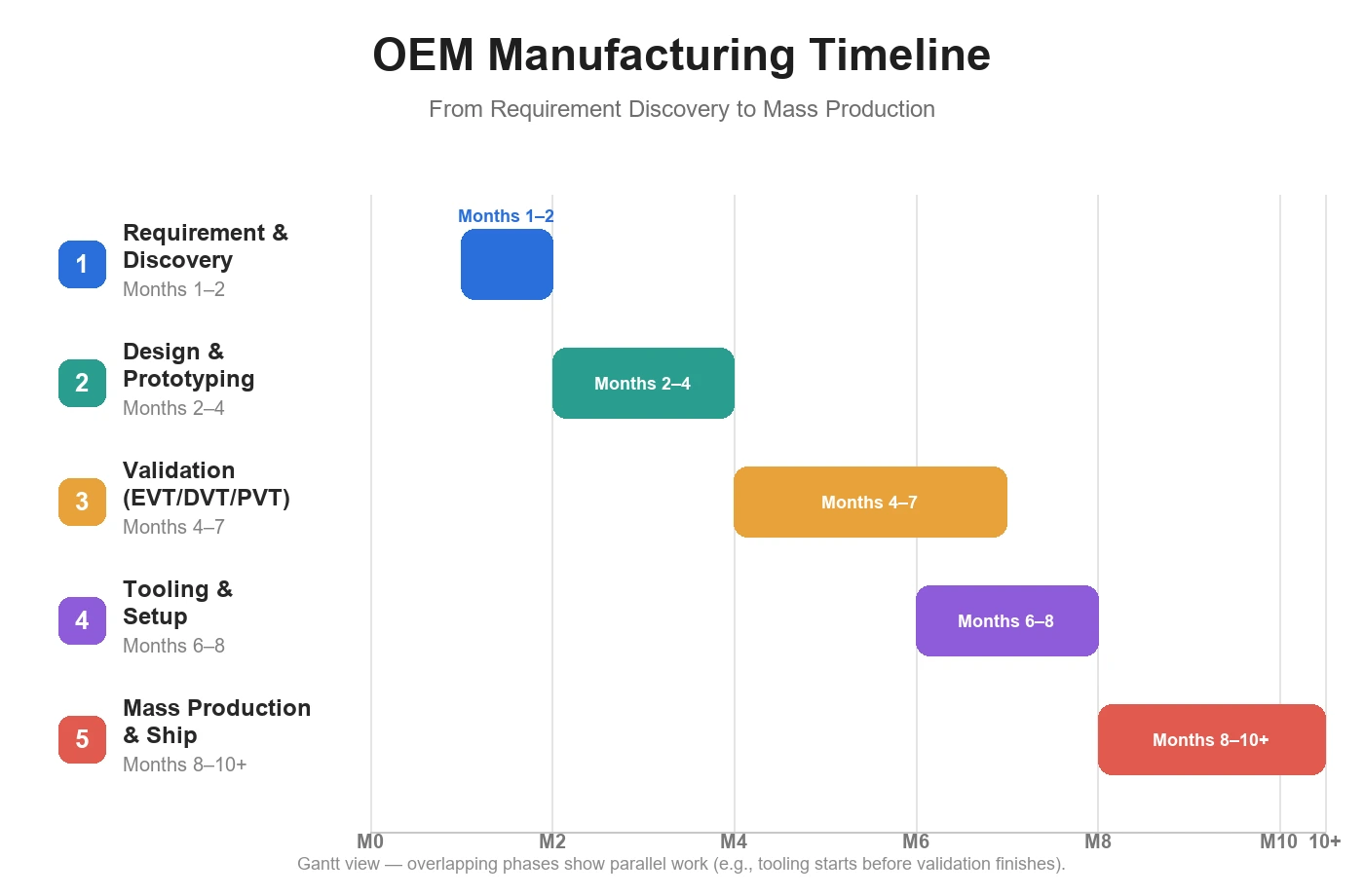
OEM Manufacturing Timeline: From Concept to Production
Typical Development Stages
Architecture & Discovery: Requirements lock, BOM draft, feature roadmap.
Engineering Design: Schematics, PCB layout, CAD modeling.
Prototyping & Validation: EVT, DVT, and PVT hardware test builds.
Tooling Setup: Steel mold production, fixture creation, line setup.
Pilot & Mass Production: Trial assembly run followed by full volume output.
Estimated Timeframe for Each Phase
| Phase | Activity | Average Duration |
| Phase 1 | Requirement Analysis & Design Specification | 3–6 Weeks |
| Phase 2 | Architecture, Schematics & Early Prototyping | 6–10 Weeks |
| Phase 3 | Validation Testing (EVT / DVT) | 8–12 Weeks |
| Phase 4 | Steel Tooling & Factory Setup | 6–8 Weeks |
| Phase 5 | PVT, Mass Production & Initial Shipment | 4–8 Weeks |
Factors That Influence Manufacturing Speed
Design Complexity: Custom wireless chipsets and complex mechanical latches add design iterations.
Supply Chain Lead Times: Hard-to-find microcontrollers or custom display modules can extend procurement periods.
Engineering Change Orders: Modifying physical designs late in the validation stage forces tooling re-works and delays schedules.
OEM Manufacturing Cost Factors
Product Complexity
Adding multi-layer PCBs, custom flexible displays, or strict ingress protection ratings increases development overhead and assembly effort.
Tooling Investment
Custom plastic injection molds, stamping dies, and automated testing fixtures represent upfront non-recurring engineering (NRE) costs.
Material Selection
Choosing premium aluminum alloys, specialized engineering plastics, or gold-plated connectors raises unit material costs compared to standard commodities.
Order Quantity (MOQ)
Higher order volumes lower individual unit price points by spreading fixed tooling and line setup costs across more devices.
Certification Requirements
Obtaining regulatory mark approvals for multiple global markets adds upfront testing laboratory fees.
Packaging & Logistics Costs
Custom printed boxes, protective retail sleeves, freight handling, and import duties directly impact overall landed product costs. Request an OEM manufacturing quote early to forecast these variables accurately.
Quality Control Throughout the OEM Manufacturing Process
Incoming Material Inspection
Technicians verify incoming passive components, bare circuit boards, ICs, and mechanical enclosures against strict dimensional and electrical tolerances before storage.
In-Process Quality Control
Inline inspectors monitor automated SMT placement, verify solder paste alignment, and track manual assembly stations to catch assembly flaws instantly.
Functional Testing
Custom test rigs flash initial firmware, check wireless signal strength, verify display output, and test physical button responses on every produced board.
Reliability Testing
Sample units undergo thermal stress chamber testing, vibration simulation, drop tests, and continuous usage cycles to verify real-world field lifespan.
Final Product Inspection
Out-of-box audits ensure finished packaging, accessories, labels, and cosmetic surfaces meet customer presentation standards before shipping.
Continuous Improvement Practices
Engineering teams evaluate defect data using statistical process control, modifying assembly procedures or component sources to raise production yields over time.
OEM Manufacturing Case Study
The Product Challenge
A smart GPS pet tracker needs to combine several technologies within a compact, lightweight enclosure. The product may require GPS positioning, wireless connectivity, rechargeable power, sensors, a charging interface, and a durable mechanical enclosure while remaining comfortable enough for everyday use by a pet.
From an OEM manufacturing perspective, the challenge is not only making each individual component work. The electronics, firmware, mechanical design, battery system, antenna performance, assembly process, and final product testing must work together as one manufacturable system.
Engineering & Product Development Approach
The development process begins by translating the product requirements into an engineering architecture. The team evaluates the required connectivity technologies, power requirements, component availability, enclosure constraints, user requirements, and target production volume before moving toward prototype development.
Manufacturing & Quality Considerations
For a connected device such as a GPS pet tracker, manufacturing quality depends on more than visual inspection. Production teams need to verify PCB assembly quality, battery connections, charging behavior, wireless communication, GPS functionality, enclosure assembly, firmware programming, and final product operation.
Production test fixtures can be used to standardize functional checks and identify defective units before products leave the manufacturing line. Incoming component inspection and in-process quality checks also help prevent supplier or assembly problems from reaching the finished product.
Supply Chain Considerations
Connected products often contain multiple electronic and mechanical components with different supplier lead times. A manufacturing partner must therefore consider component availability, alternative sourcing options, minimum order quantities, lifecycle status, and production demand when preparing the product for scale.
Early supply chain planning can reduce the risk of production interruptions caused by component shortages or unexpected supplier changes. This is particularly important when a product is expected to transition from an initial production run to higher-volume manufacturing.
Production Outcome
The goal of this type of OEM development process is to transform a functional product concept into a repeatable manufacturing system. By validating the design before mass production, establishing production tooling and test procedures, and controlling component and assembly quality, businesses can reduce avoidable manufacturing risks as production volume increases.
Key Lessons for Businesses
- Product design and manufacturing engineering should be considered together from the beginning.
- Prototype validation can identify problems before expensive production tooling and mass manufacturing.
- Component availability should be considered during product development rather than after the design is finalized.
- Production testing should be designed around the product’s critical electrical, mechanical, and functional requirements.
- A capable OEM partner can coordinate engineering, sourcing, validation, tooling, quality control, and production under one manufacturing process.
Editorial note: This is an illustrative OEM manufacturing example created to explain how a smart connected device can progress from product requirements through engineering, validation, tooling, and mass production. Project specifications, timelines, quantities, and results vary by product and customer requirements. For a published customer case study, use verified Precintl project information and disclose only details approved for public use.
Conclusion
Building custom hardware requires balancing engineering precision, supply chain resilience, and rigorous factory oversight. Partnering with an experienced partner like Precintl allows your business to bring ideas into mass production while mitigating technical and financial risks.
Whether launching a new smart device or scaling up existing device hardware, requesting an OEM manufacturing consultation early gives your engineering team a direct path from concept to global delivery.
Frequently Asked Questions
01 What is an Original Equipment Manufacturer (OEM)?
An Original Equipment Manufacturer is a company that builds hardware, components, or complete finished products according to a client’s custom design specifications and branding requirements.
02 What is the difference between OEM and ODM?
In OEM manufacturing, the client provides the custom design, schematics, and mechanical layouts, maintaining full intellectual property ownership. In ODM manufacturing, the customer buys a pre-designed product built by the factory and applies their own logo.
03 What are the benefits of working with an OEM manufacturer?
Working with an OEM manufacturer grants complete product customization control, access to established factory equipment, reduced capital expenditure risks, faster production launch cycles, and lower unit costs at scale.
04 How do I choose the right OEM manufacturing partner?
Look for a partner with proven technical experience in your specific device category, relevant ISO quality certifications, transparent project management practices, strong supply chain networks, and flexible scaling capacity.
05 Which industries commonly use OEM manufacturing?
OEM manufacturing is widely used across consumer electronics, smart home automation, medical devices, automotive electronics, commercial enterprise systems, and industrial hardware sectors.
Helpful Manufacturing Resources
The following resources can help businesses better understand international manufacturing standards, product compliance, quality management, and technical requirements when developing and producing hardware products.
- ISO Standards ↗ Explore international standards covering quality management, manufacturing processes, safety, and other business requirements.
- International Electrotechnical Commission (IEC) ↗ Reference technical standards and publications relevant to electrical and electronic products.
- FCC Office of Engineering and Technology ↗ Review regulatory and technical information relevant to radio-frequency devices and electronic products entering the U.S. market.