Bringing a physical product to market requires navigating engineering decisions, tooling investments, and global supply chains. Whether you need a handful of precision prototypes or full mass production, choosing the right production approach determines your product’s unit economics, speed to market, and long-term viability.
This guide breaks down every phase of custom manufacturing, giving engineering teams, product developers, and hardware companies a practical blueprint for turning ideas into finished goods.
What Is Custom Manufacturing?
Custom manufacturing is the design, engineering, and fabrication of parts, components, or complete assemblies tailored to exact customer specifications rather than mass-produced for off-the-shelf stock. Unlike standard catalog items, every geometric feature, material selection, surface finish, and mechanical tolerance reflects unique project requirements. Companies turn to a specialized custom manufacturer when commercial off-the-shelf (COTS) parts cannot meet their dimensional, structural, or performance criteria.
| Customization Spectrum | Manufacturing Approach | Key Features |
| Full Customization | Proprietary Tooling & Custom Design | Tailored geometry, custom materials, unique electronics |
| Hybrid Approach | COTS Modification | Standard enclosures, custom CNC cutouts, custom powder coating |
| Standard Production | Off-the-Shelf Catalog | Catalog parts, zero tooling investment, fast delivery |
Custom Manufacturing vs OEM, ODM & Contract Manufacturing
Selecting the right production model requires understanding how ownership, design responsibility, and manufacturing capabilities differ across industry models:
| Manufacturing Model | Design Ownership | Tooling Ownership | Production Customization | Best For |
| Custom Manufacturing | Customer | Customer | High (100% custom specs) | Unique hardware, proprietary consumer electronics, complex assemblies |
| OEM Manufacturing Services | Customer | Customer | Medium to High | Existing brands outsourcing production of their exact design |
| ODM Manufacturing Services | Supplier | Supplier | Low to Medium (White label) | Rapid market testing with minimal up-front engineering investment |
| Contract Custom Manufacturing | Customer | Customer / Shared | High | Scaled commercial production across specialized factories |
When you leverage product manufacturing services through contract custom manufacturing, you retain 100% of your intellectual property while utilizing advanced factory floor infrastructure without incurring massive capital expenditures.
Related: 20 Wearable Technology Product Ideas for New Businesses
When Should You Use Custom Manufacturing?
Custom manufacturing is necessary when standard components fail to fulfill specific technical, regulatory, or functional mandates. Key drivers include:
- Proprietary Mechanical Geometry: Product enclosures require tight space constraints or ergonomic contouring that off-the-shelf boxes cannot accommodate.
- Specific Material Capabilities: Applications requiring biocompatible plastics, specialized heat-treated aluminum alloys, or custom silicone formulations.
- Performance Optimization: Tight engineering tolerances (down to ±0.005 mm) that ensure proper fit and function in high-stress assemblies.
- Brand Differentiation: Consumer electronics, medical devices, and smart hardware needing a distinctive aesthetic identity.
How Does the Custom Manufacturing Process Work?
Moving from an initial concept to finished inventory involves a structured, multi-phase progression. Skipping validation phases or rushing into hard tooling often leads to costly engineering changes late in the lifecycle.
- Idea & Conceptualization: Defining functional goals, product scope, and target markets.
- CAD Design & Engineering: Creating 3D mechanical models and comprehensive Bill of Materials (BOM).
- DFM & Prototyping: Conducting manufacturability reviews and producing physical prototype iterations.
- Tooling & Pilot Run: Fabricating production molds/dies and executing low-volume pilot test runs.
- Mass Manufacturing: Ramping up full-scale commercial production and final product assembly.
Product Requirements and Engineering
Every custom engineering project begins with clear documentation. Establishing a Product Requirement Document (PRD) outlines essential physical dimensions, operating environments, thermal targets, compliance certifications, and target cost metrics.
Engineers translate these product requirement documents into preliminary 3D CAD models and mechanical layouts, resolving spatial interference, structural loads, and fastener placement early in the process.
DFM, Prototyping and Product Validation
Design for Manufacturability (DFM) bridges conceptual design and factory implementation. Experienced manufacturing engineers review part geometries to identify sink marks, sharp corners, draft angle deficiencies, or tight internal radii that complicate machining or molding.
Once DFM revisions are integrated, prototype development and testing begins. Physical prototypes allow engineers to verify form, fit, and mechanical function through hands-on bench testing before committing capital to production tooling.
Tooling, Pilot Production and Mass Manufacturing
Transitioning from custom manufacturing prototype to mass production requires tooling creation, such as steel or aluminum injection molds, stamping dies, or specialized CNC fixtures.
- Tooling Fabrication: Precision EDM (Electrical Discharge Machining) and high-speed CNC milling form the mold cavities.
- Pilot Run (T1-T3 Samples): Short production batches establish baseline factory control parameters and yield rates.
- Mass Manufacturing: Once pilot samples meet all quality criteria, full-scale custom manufacturing for businesses begins.
Custom Manufacturing Services
Achieving optimal component quality requires pairing the right geometry with the appropriate manufacturing process.
CNC Machining and Custom Metal Parts
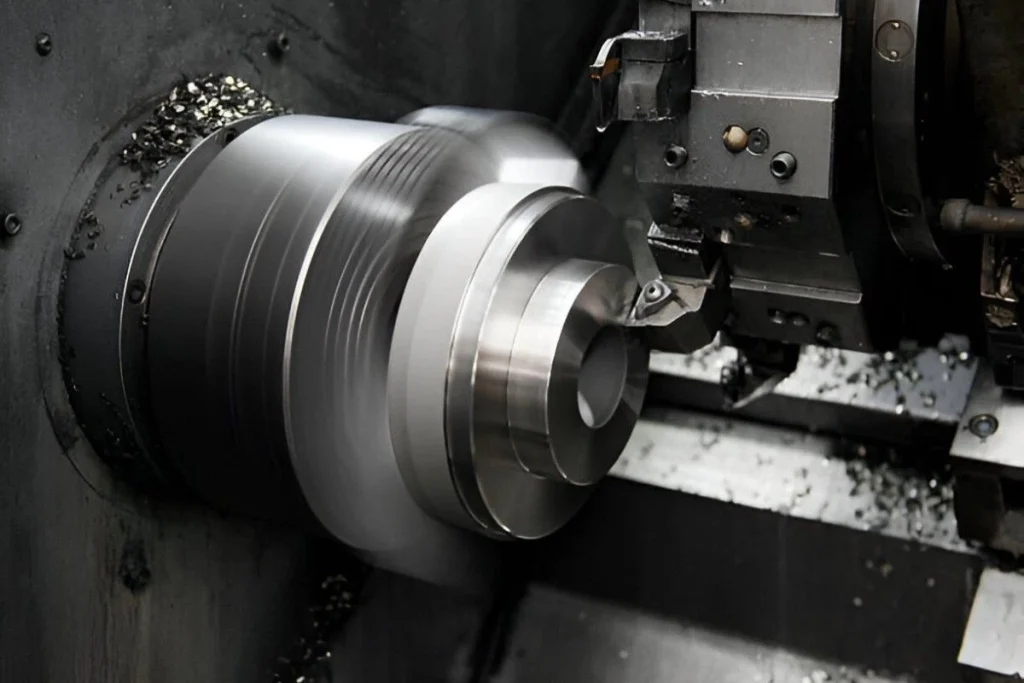
For tight tolerance hardware and low-to-medium volume production, CNC machining services offer exceptional accuracy without upfront tooling fees.
- Capabilities: 3-axis, 4-axis, and 5-axis milling, along with live-tool CNC turning.
- Tolerances: Standard ISO 2768-m up to precision ±0.005 mm limits.
- Applications: Custom machined parts, custom metal parts, structural brackets, robotic arms, and heat sinks.
Injection Molding and Plastic Manufacturing
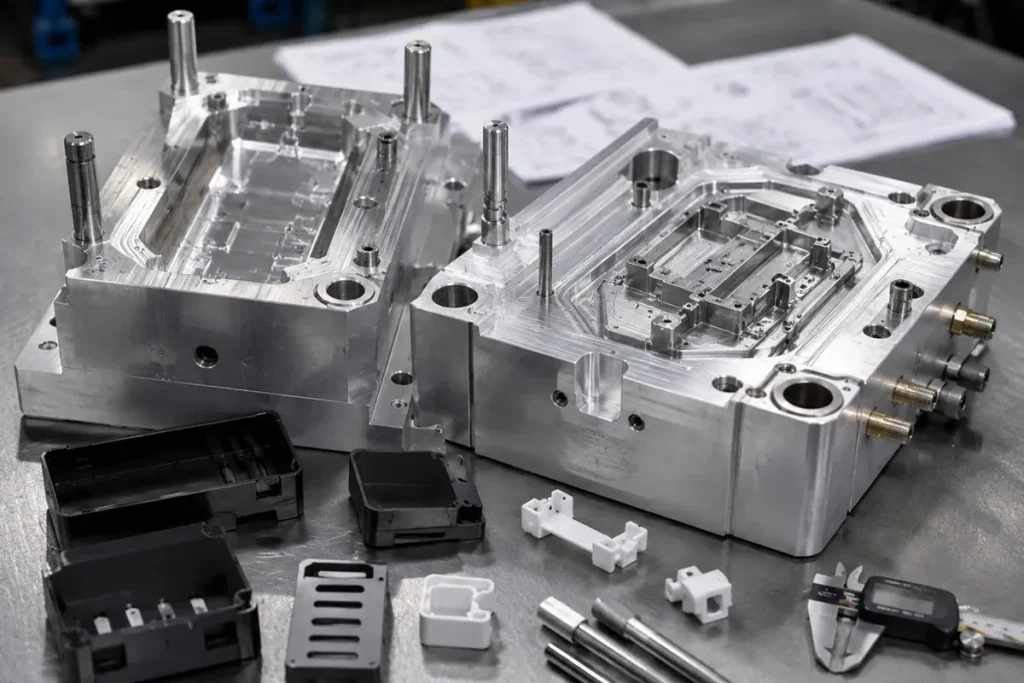
When scaling plastic components past 1,000 units, custom injection molding becomes the primary process for cost efficiency.
- Tooling Types: Rapid aluminum tooling for low volumes (1,000–10,000 units); hardened NAK80 or S136 steel tooling for high volumes (>100,000 units).
- Key Consideration: Proper wall thickness, draft angles (1.5°–2°), and uniform cooling channels prevent part warping and cosmetic sink marks.
- Products: Enclosures, custom plastic parts, light pipes, internal gear frames, and custom plastic manufacturing components.
Sheet Metal, Die Casting and Aluminum Extrusion
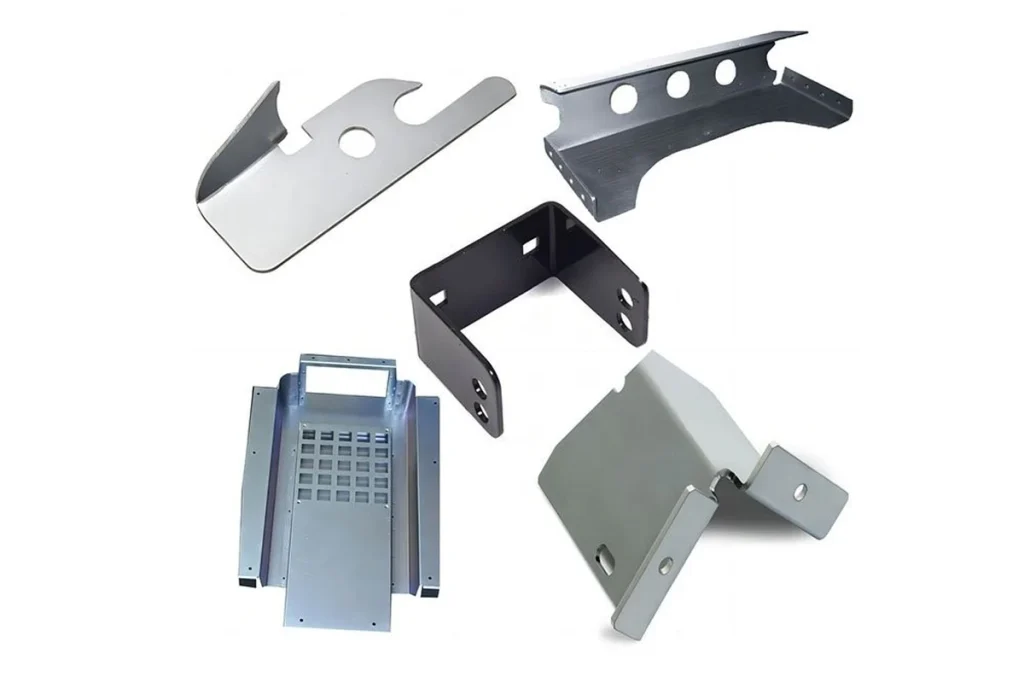
For structural rigidity, thermal dissipation, or thin-walled enclosures, secondary metal fabrication methods provide tailored performance:
| Process | Best For | Key Advantage |
|---|---|---|
| Custom Sheet Metal Fabrication | Enclosures, chassis, brackets | Low tooling cost, high structural durability |
| Custom Die Casting | Complex 3D metal housings | High volume production speed, tight tolerances |
| Custom Aluminum Extrusion | Linear structural profiles | Constant cross-section, cost-effective tooling |
Integrating custom fabrication services, custom aluminum manufacturing, custom metal fabrication, and specialized custom sheet metal fabrication allows hardware teams to optimize weight and strength across structural assemblies.
PCB Manufacturing, PCBA and Product Assembly
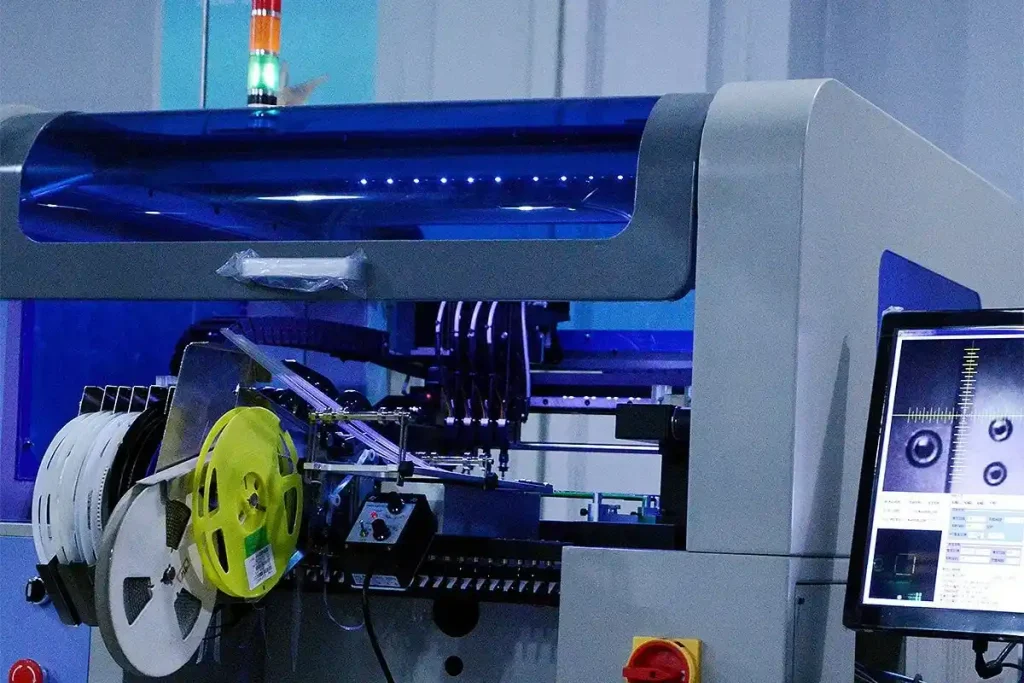
Smart hardware requires seamless integration of mechanical housing and electronic assemblies. Comprehensive custom electronic manufacturing encompasses:
- Bare PCB Fabrication: Rigid, flex, or rigid-flex multi-layer boards.
- Surface Mount Technology (SMT): High-speed automated pick-and-place component mounting.
- Through-Hole Technology (THT): Manual or wave soldering for heavy power connectors.
- Box Build Assembly: Integrating PCBA, mechanical enclosures, wire harnesses, and displays into a finished product.
Work with a reliable partner offering electronics manufacturing services to prevent costly signal integrity or thermal issues during assembly. Explore the PCB design guide, along with the ODM manufacturing guide.
Custom Product Development From Idea to Production
Transforming a back-of-the-napkin sketch into a commercial product follows a disciplined engineering framework. Combining custom product design and manufacturing under a unified workflow minimizes communication gaps between designers and factory operators.
- Stage 1: Idea / Concept
- Initial specification and feasibility study.
- Stage 2: CAD & BOM Development
- Detailed 3D modeling and component sourcing specification.
- Stage 3: EVT (Engineering Validation Test)
- Core functional verification using prototype tooling or CNC parts.
- Stage 4: DVT (Design Validation Test)
- Cosmetic consistency and regulatory compliance testing using final materials.
- Stage 5: PVT (Production Validation Test)
- Assembly line yield and cycle speed optimization at final target facilities.
- Stage 6: Mass Production
- Full-scale manufacturing run and global shipping deployment.
Product Design, CAD and BOM Development
The design phase establishes the parametric foundation of your product. Engineers create native 3D STEP models alongside detailed 2D engineering drawings with Geometric Dimensioning and Tolerancing (GD&T).
Simultaneously, a structured Bill of Materials (BOM) is created. The BOM specifies every resistor, screw, molded shell, silicon gasket, and packaging element, including part numbers, manufacturer details, unit quantities, and second-source alternatives.
Prototype Development and Testing
Initial prototypes rely on additive manufacturing (SLA/SLS 3D printing) or CNC machining to validate form factor and human ergonomics. As designs mature, functional prototypes utilize production-grade materials to verify mechanical endurance, thermal dissipation, ingress protection (IP ratings), and drop testing resilience.
EVT, DVT and PVT
Hardware engineering relies on three critical validation stage gates before approving full mass production:
- EVT (Engineering Validation Test): Focuses on core functional performance. Uses prototype tooling or CNC parts to confirm the electronics and mechanical systems work as designed.
- DVT (Design Validation Test): Focuses on cosmetic consistency and regulatory compliance. Uses final materials and production-intent tooling to pass FCC, CE, or UL testing.
- PVT (Production Validation Test): Focuses on manufacturing line efficiency and assembly yield. Runs on actual mass production equipment at target factory line speeds.
Adhering strictly to custom hardware development frameworks prevents premature scaling issues and ensures smooth transitions from prototype to mass production.
Related: NPI Manufacturing: Complete Guide to EVT, DVT, PVT & Mass Production
Custom Manufacturing Materials
Material selection directly impacts unit cost, structural strength, weight, cosmetic finish, and manufacturing cycle times.
Metals and Alloys
- Aluminum 6061-T6: Easy to machine, excelente strength-to-weight ratio, highly anodizable.
- Aluminum 7075: High-strength aerospace alloy used for high-stress structural parts.
- Stainless Steel (304 / 316L): Outstanding corrosion resistance and toughness; ideal for medical devices and food-contact hardware.
- Brass (C36000): Low friction coefficient, ideal for threaded inserts, valves, and precision bushings.
Engineering Plastics
- ABS (Acrylonitrile Butadiene Styrene): Impact resistant and easily moldable; standard for consumer hardware enclosures.
- Polycarbonate (PC): High impact strength and optical clarity; commonly blended with ABS (PC-ABS) for rigid structural shells.
- POM (Acetal / Delrin): High stiffness, low friction, and excellent dimensional stability for gears and bearings.
- PEEK: High-performance thermoplastic designed to withstand extreme thermal and chemical environments.
How to Choose the Right Material
Selecting the optimal material requires balancing mechanical stress, environment, and cost:
- Evaluate Operating Environment: Operating temperature ranges, chemical exposure, UV exposure, and ingress requirements.
- Determine Structural Loads: Yield strength requirements, fatigue limits, and impact resistance.
- Review Cosmetic Standards: Post-processing compatibility (anodizing, powder coating, bead blasting, or texture polishing).
- Factor in Cost Constraints: Raw material costs vary significantly—machining PEEK costs far more than ABS for identical geometries.
How Much Does Custom Manufacturing Cost?
Managing your custom manufacturing cost requires a clear understanding of fixed capital expenditures versus variable per-unit expenses.
Major Factors That Affect Manufacturing Cost
- Material Selection: Exotic alloys or specialty engineering resins increase raw material costs.
- Part Complexity & Geometry: Multi-axis CNC tool movement or complex mold action slides increase machining cycle times.
- Tolerances & Surface Finishes: Micron-level tolerances require slower cutting speeds, specialized inspection, and higher scrap rates.
- Labor & Secondary Operations: Manual assembly, post-processing, custom painting, laser engraving, and silk-screening increase labor unit costs.
Tooling, MOQ and Production Volume
Fixed tooling investments skew unit economics heavily at lower volumes:
Effective Unit Cost = Per-Unit Production Cost + (Total Tooling Cost / Production Volume)
Higher Minimum Order Quantities (MOQs) allow manufacturers to amortize setup costs across thousands of units, reducing overall cost per part.
Prototype vs Mass Production Costs
| Cost Dimension | Prototype Phase | Mass Production Phase |
|---|---|---|
| Unit Cost | High ($50–$500+ per unit) | Low ($2–$20 per unit) |
| Tooling Investment | Minimal (Zero hard tooling) | High ($5,000–$50,000+ for molds) |
| Lead Time | 3–10 Days | 30–60 Days (including tooling build) |
| Process Flexibility | Very High (Easy design iterations) | Low (Tooling modification is expensive) |
Understanding these trade-offs helps engineering leads allocate hardware budgets effectively across different development stages.
Quality Control in Custom Manufacturing
Consistent quality control protects your brand, prevents product recalls, and reduces factory waste.
| Inspection Stage | Full Name | Primary Focus |
|---|---|---|
| IQC | Incoming Quality Control | Inspecting raw materials, resin pellets, and COTS hardware |
| IPQC | In-Process Quality Control | Conducting first-piece checks and monitoring SPC dimensions during runs |
| FQC | Final Quality Control | Performing cosmetic audits and functional bench testing |
| OQA | Outgoing Quality Assurance | Verifying packaging integrity, drop test resilience, and pre-shipment requirements |
Incoming and In-Process Quality Inspection
Quality management begins before production starts on the factory floor:
- Incoming Quality Control (IQC): Verifies raw materials, metal billets, resin pellets, and electronic components against material certifications (RoHS, REACH).
- In-Process Quality Control (IPQC): Machine operators conduct first-piece inspections and sample parts at defined intervals during production runs to monitor machine drift.
Final Inspection and Functional Testing
Completed items undergo rigorous Outgoing Quality Assurance (OQA):
- Dimensional Verification: Coordinate Measuring Machines (CMM) and optical comparators verify critical-to-quality (CTQ) dimensions.
- Functional Testing: Automated test fixtures burn in PCBA boards, cycle mechanical buttons, test thermal output, and verify wireless communication modules.
- Cosmetic Auditing: Controlled lighting booths evaluate surface finish uniformity and color accuracy against Pantone references.
Tolerances, AQL and Product Traceability
- Acceptable Quality Limit (AQL): Standard sampling frameworks (ISO 2859-1 / ANSI/ASQ Z1.4) define the maximum allowable defective units in a shipment sample.
- Product Traceability: Marking parts with serialized laser etching or QR codes links components back to raw material batches, machine operators, and production timestamps.
Robust custom manufacturing quality control protocols provide complete transparency across every shipment.
How to Choose a Custom Manufacturing Company
Partnering with the right custom product manufacturer determines whether your product launches on schedule or encounters production stalls.
Engineering and Manufacturing Capabilities
Assess whether a potential custom manufacturing supplier provides dedicated DFM support, cross-disciplinary mechanical/electrical expertise, and diverse fabrication equipment. Suppliers offering custom engineering services and customized engineering solutions resolve manufacturability issues before cutting steel.
Quality Systems and Testing Facilities
Inquire about formal industry certifications and internal inspection facilities:
- ISO 9001: Standard quality management framework.
- ISO 13485: Medical device manufacturing compliance.
- IATF 16949: Automotive supplier quality standards.
- In-House Lab Facilities: X-ray inspection for PCBA voids, salt spray chambers for corrosion testing, pull-test stands, and CMM equipment.
Production Capacity and Global Supply Chain Support
Ensure your custom manufacturing partner can scale seamlessly as sales volume expands. A resilient supplier maintains strong relationships across raw material vendors, secondary finishing houses, and global freight partners, shielding your custom manufacturing supply chain from unexpected disruptions.
Custom Manufacturing in China
China remains a global hub for custom product manufacturing services due to its mature industrial supply ecosystems, skilled labor, and rapid prototyping capabilities.
Benefits of Working With a China-Based Manufacturer
- Concentrated Industrial Supply Chains: Raw materials, surface finishing, specialized hardware, and electronic components reside within tight geographic clusters, speeding up turnaround times.
- Cost Efficiency: Competitive tooling expenses and adaptable labor lower up-front capital requirements.
- Agile Prototyping Capabilities: Rapid turnaround on complex CNC parts and prototype tooling allows hardware startups to iterate quickly.
Leveraging a local custom manufacturing company China partner provides access to high-volume output while maintaining cost competitiveness.
Quality Control and Global Logistics
To maximize reliability when utilizing custom manufacturing China operations:
- Establish On-Site Quality Presence: Work with bilingual engineering managers who inspect production lines locally.
- Define Clear Engineering Drawings: Use unambiguous GD&T specifications rather than relying on informal email descriptions.
- Manage Export Logistics: Partner with suppliers experienced in international shipping regulations, duty compliance, and Incoterms (FOB, DDP, DAP).
Common Custom Manufacturing Challenges
Navigating custom hardware projects involves overcoming recurring engineering and operational hurdles.
Design and DFM Problems
- Issue: Wall thickness variations leading to sink marks and internal void pockets in injection molded parts.
- Solution: Conduct plastic flow simulation (Moldflow analysis) during early design phases and maintain uniform wall thickness.
Quality, Cost and Lead-Time Issues
- Issue: Unexpected cost spikes and shipping delays driven by non-standard fastener selections or over-engineered tolerances.
- Solution: Standardize COTS fasteners wherever possible, apply loose tolerances to non-critical dimensions, and lock design specifications prior to pilot tooling.
How to Reduce Manufacturing Risks
- Build Hardware Iteratively: Progress systematically through EVT, DVT, and PVT stage gates.
- Maintain Clear Version Control: Lock CAD revisions, Gerber files, and BOM spreadsheets inside dedicated PDM systems.
- Perform Factory Audits: Audit supplier facility capabilities, quality management systems, and financial health before placing large purchase orders.
Why Businesses Choose Precintl for Custom Manufacturing
Precintl delivers end-to-end custom product development and manufacturing services, helping brands transform innovative ideas into scalable commercial products.
| Service Phase | Scope & Key Deliverables |
|---|---|
| Concept & Engineering | Concept refinement, CAD design, and DFM optimization |
| Validation & NPI | Rapid prototyping, functional testing, and EVT/DVT/PVT stages |
| Quality & Scaling | In-house quality control, CMM testing, and mass manufacturing |
| Supply Chain & Delivery | Sourcing across 2,000+ vetted suppliers and global door-to-door logistics |
Product Design and Engineering Experience
Our engineering team leverages deep expertise in custom hardware manufacturing, electro-mechanical design, and advanced DFM analysis. We partner directly with your team to refine product geometry, minimize assembly piece count, and optimize unit economics.
Prototyping, NPI and Product Validation
Precintl streamlines New Product Introduction (NPI) workflows. We move your hardware project from initial 3D printed models to high-precision CNC prototypes, validating every detail through formal EVT, DVT, and PVT phases.
In-House Testing and Quality Control
Quality is embedded directly into our production processes. Utilizing advanced CMM verification, automated optical inspection (AOI), environmental testing chambers, and functional bench testing, Precintl ensures every production shipment meets strict dimensional tolerances through robust quality control processes.
2,000+ Vetted Suppliers and Global Manufacturing Support
Precintl coordinates an extensive network of over 2,000 audited manufacturing partners and specialized suppliers. This global reach ensures competitive pricing, redundant production capacity, and reliable raw material supply across diverse industries, including custom manufacturing for consumer electronics, industrial machinery, and medical devices.
From Product Concept to Mass Production
Whether you are an emerging hardware brand launching a flagship product or an established business optimizing an existing supply chain, Precintl serves as your reliable OEM manufacturing and ODM manufacturing partner. We oversee design, tooling fabrication, quality control, and global shipping under one unified management system. Contact Precintl for your manufacturing project.
Frequently Asked Questions About Custom Manufacturing
What is custom manufacturing?
Custom manufacturing is the design, engineering, and production of parts, components, or complete assemblies engineered specifically to meet unique customer specifications, rather than mass-producing off-the-shelf catalog items.
How much does custom manufacturing cost?
Costs vary widely based on production volume, material selection, geometric complexity, and tooling requirements. Initial prototype phases range from $50 to $500+ per part, while high-volume injection molded or stamped components can drop to $0.50 to $10.00 per unit after tooling costs are amortized.
What is the MOQ for custom manufacturing?
Minimum Order Quantities (MOQs) depend on the selected process. CNC machining and sheet metal prototyping often have MOQs as low as 1 to 10 units. Injection molding, die casting, and custom extrusions generally carry MOQs of 1,000 to 5,000 units to offset machine setup and tooling costs.
How long does custom manufacturing take?
Turnaround times depend on product complexity and tooling needs. Fast-turn prototype parts made via CNC or 3D printing take 3 to 10 business days. Full production runs requiring specialized injection molds or die-casting tooling typically take 4 to 8 weeks for tool build, sample validation, and initial mass production.
Can a manufacturer develop a product from an idea?
Yes. Full-service engineering partners like Precintl assist at every stage, turning early sketches or conceptual ideas into detailed 3D CAD models, functional prototypes, production-ready BOMs, and mass-manufactured end products.
What is the difference between custom manufacturing and OEM?
Custom manufacturing covers any tailor-made production process executed to specific customer requirements. OEM (Original Equipment Manufacturer) specifically describes a business model where a factory produces components or complete products based entirely on the buying company’s proprietary designs and brand specifications.